The Amboseli Conservation Program (ACP) continues to monitoring wildlife, livestock, settlements and vegetation in the national park and across the ecosystem. David Maitumo conducts regular ground counts and David Western monthly aerial counts of the Amboseli Basin. ACP also commissioned the Department of Resource Surveys and Remote Sensing (DRSRS) to undertake an aerial survey of the 8,500 square kilometre ecosystem in May. The results of the ground and aerial counts are in close agreement, showing strong recovery in wildlife populations over the last three years, following four years of paltry rebound after the population crashes during the 2009 drought.
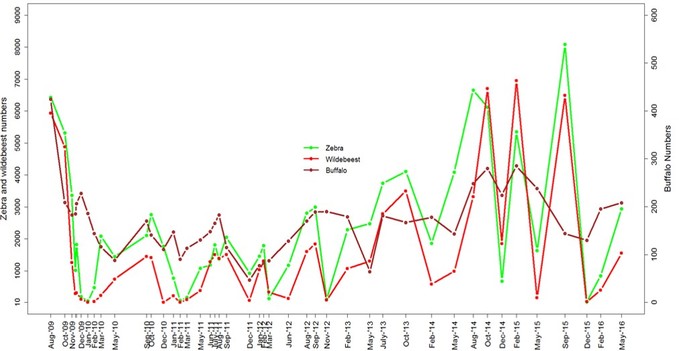
The recovery of wildlife numbers in the aftermath of the 2009 drought was far slower than in the 1970s drought, due to the larger losses of herbivores and heavier predation levels by lions and hyenas. The lag in recovery shows up in the prolonged low population numbers of zebra, wildebeest and buffalo from 2010 to 2014. The small populations of wildlife caused heavy predation on livestock and growing resentment among herders. The last two years have seen a strong recovery in all herbivores once the numbers breached the predation threshold. The seasonal migrations have also picked up again, as shown in the graph. Of special interest is the resumption of migrations by buffalo, which ceased after elephants open up swamp-edge grazing following compression by poaching in the 1970s. The resumption of seasonal migrations spares buffalo heavy predation in the basin during the rains.
The trends point to a healthy ecological balance returning to the Amboseli ecosystem after the 2009 population crash. With wildlife ungulates approaching their pre-drought levels, carnivores have more wild prey and less need to attack domestic stock. The larger numbers have also precipitate the resumption of strong seasonal migrations during the rains.
The ecosystem-wide surveys commissioned by ACP and conducted by DRSRS in May further confirm the recovery of wildlife numbers. Elephants are back to their pre-drought levels and continue to grow in numbers and expand their range. Zebra numbers have recovered their pre-drought levels of 16,000. Wildebeest numbers have also picked up in the past three years, but at 9,000 still fall short of the pre-drought levels of 17,000.
The Amboseli Conservation Program (ACP) continues to monitoring wildlife, livestock, settlements and vegetation in the national park and across the ecosystem. David Maitumo conducts regular ground counts and David Western monthly aerial counts of the Amboseli Basin. ACP also commissioned the Department of Resource Surveys and Remote Sensing (DRSRS) to undertake an aerial survey of the 8,500 square kilometre ecosystem in May. The results of the ground and aerial counts are in close agreement, showing strong recovery in wildlife populations over the last three years, following four years of paltry rebound after the population crashes during the 2009 drought.
The recovery of wildlife numbers in the aftermath of the 2009 drought was far slower than in the 1970s drought, due to the larger losses of herbivores and heavier predation levels by lions and hyenas. The lag in recovery shows up in the prolonged low population numbers of zebra, wildebeest and buffalo from 2010 to 2014. The small populations of wildlife caused heavy predation on livestock and growing resentment among herders. The last two years have seen a strong recovery in all herbivores once the numbers breached the predation threshold. The seasonal migrations have also picked up again, as shown in the graph. Of special interest is the resumption of migrations by buffalo, which ceased after elephants open up swamp-edge grazing following compression by poaching in the 1970s. The resumption of seasonal migrations spares buffalo heavy predation in the basin during the rains.
The trends point to a healthy ecological balance returning to the Amboseli ecosystem after the 2009 population crash. With wildlife ungulates approaching their pre-drought levels, carnivores have more wild prey and less need to attack domestic stock. The larger numbers have also precipitate the resumption of strong seasonal migrations during the rains.
The ecosystem-wide surveys commissioned by ACP and conducted by DRSRS in May further confirm the recovery of wildlife numbers. Elephants are back to their pre-drought levels and continue to grow in numbers and expand their range. Zebra numbers have recovered their pre-drought levels of 16,000. Wildebeest numbers have also picked up in the past three years, but at 9,000 still fall short of the pre-drought levels of 17,000.
The Amboseli Conservation Program (ACP) continues to monitoring wildlife, livestock, settlements and vegetation in the national park and across the ecosystem. David Maitumo conducts regular ground counts and David Western monthly aerial counts of the Amboseli Basin. ACP also commissioned the Department of Resource Surveys and Remote Sensing (DRSRS) to undertake an aerial survey of the 8,500 square kilometre ecosystem in May. The results of the ground and aerial counts are in close agreement, showing strong recovery in wildlife populations over the last three years, following four years of paltry rebound after the population crashes during the 2009 drought.
The recovery of wildlife numbers in the aftermath of the 2009 drought was far slower than in the 1970s drought, due to the larger losses of herbivores and heavier predation levels by lions and hyenas. The lag in recovery shows up in the prolonged low population numbers of zebra, wildebeest and buffalo from 2010 to 2014. The small populations of wildlife caused heavy predation on livestock and growing resentment among herders. The last two years have seen a strong recovery in all herbivores once the numbers breached the predation threshold. The seasonal migrations have also picked up again, as shown in the graph. Of special interest is the resumption of migrations by buffalo, which ceased after elephants open up swamp-edge grazing following compression by poaching in the 1970s. The resumption of seasonal migrations spares buffalo heavy predation in the basin during the rains.
The trends point to a healthy ecological balance returning to the Amboseli ecosystem after the 2009 population crash. With wildlife ungulates approaching their pre-drought levels, carnivores have more wild prey and less need to attack domestic stock. The larger numbers have also precipitate the resumption of strong seasonal migrations during the rains.
The ecosystem-wide surveys commissioned by ACP and conducted by DRSRS in May further confirm the recovery of wildlife numbers. Elephants are back to their pre-drought levels and continue to grow in numbers and expand their range. Zebra numbers have recovered their pre-drought levels of 16,000. Wildebeest numbers have also picked up in the past three years, but at 9,000 still fall short of the pre-drought levels of 17,000.
The Amboseli Conservation Program (ACP) continues to monitoring wildlife, livestock, settlements and vegetation in the national park and across the ecosystem. David Maitumo conducts regular ground counts and David Western monthly aerial counts of the Amboseli Basin. ACP also commissioned the Department of Resource Surveys and Remote Sensing (DRSRS) to undertake an aerial survey of the 8,500 square kilometre ecosystem in May. The results of the ground and aerial counts are in close agreement, showing strong recovery in wildlife populations over the last three years, following four years of paltry rebound after the population crashes during the 2009 drought.
The recovery of wildlife numbers in the aftermath of the 2009 drought was far slower than in the 1970s drought, due to the larger losses of herbivores and heavier predation levels by lions and hyenas. The lag in recovery shows up in the prolonged low population numbers of zebra, wildebeest and buffalo from 2010 to 2014. The small populations of wildlife caused heavy predation on livestock and growing resentment among herders. The last two years have seen a strong recovery in all herbivores once the numbers breached the predation threshold. The seasonal migrations have also picked up again, as shown in the graph. Of special interest is the resumption of migrations by buffalo, which ceased after elephants open up swamp-edge grazing following compression by poaching in the 1970s. The resumption of seasonal migrations spares buffalo heavy predation in the basin during the rains.
The trends point to a healthy ecological balance returning to the Amboseli ecosystem after the 2009 population crash. With wildlife ungulates approaching their pre-drought levels, carnivores have more wild prey and less need to attack domestic stock. The larger numbers have also precipitate the resumption of strong seasonal migrations during the rains.
The ecosystem-wide surveys commissioned by ACP and conducted by DRSRS in May further confirm the recovery of wildlife numbers. Elephants are back to their pre-drought levels and continue to grow in numbers and expand their range. Zebra numbers have recovered their pre-drought levels of 16,000. Wildebeest numbers have also picked up in the past three years, but at 9,000 still fall short of the pre-drought levels of 17,000.