
The Amboseli Ecosystem Management Plan (AEMP) was initiated by ACP and ACC in 2004 to urge the Maasai landowner association to call on Kenya Wildlife Service, other government agencies, conservation organizations, tourism industry and researchers to draw up a conservation plan for the Amboseli ecosystem.
The effort led to the launch a ten year AEMP plan for 2008 to 2018. The aim of ecosystem plan, the first of its kind, was to maintain the viability of the Amboseli migratory wildlife populations.
The plan recognized that pastoral herders also moved seasonally in much the same way as wildlife. With this mind, AEMP defined a Minimum Viable Area for sustaining wildlife and pastoral herds, the threats to the integrity of the ecosystem, and proposed specific mitigation measures.
The renewal of AEMP for a further 10 years is currently underway. ACP has, as in the original planning process, drawn up a detailed report providing the background materials for the new. The report was completed in April and submitted to the planning committee overseeing AEMP 2018-2028.
The ACP report points out that the new plan must take into account the recommendations of the Strategic Environmental Assessment commissioned by the Amboseli Ecosystem Trust and gazetted by the National Environmental Management Authority. The new plan must also include plans for livestock development, rangeland and water management, agriculture, permanent settlements, and allow for urbanization and new enterprises. The plan should also address the changes over the last decade.
The threats detailed in the ACP 2007 report, which have intensified since then, include subdivision, agricultural expansion, water extraction for farms and development, a loss of seasonal pastures, and the growing impact of grazers and browsers on habitat, species diversity, plant production and on livestock and wildlife populations. Poaching has declined to manageable levels since 2008, due to the formation of a large well-managed community ranger force. Human-wildlife conflict has, however, risen sharply to the point of undercutting gains in community-based conservation.
The social, economic and demographic changes underway among the predominantly pastoral community of the Amboseli ecosystem are causing fundamental changes in livelihoods, both out of necessity and choice. In the long run, social and economic development is likely to relieve the pressure on land. Meanwhile, for the many pastoralists who remain herders, land subdivision, sedentarization and a loss of seasonal grazing decreases their mobility, herd sizes and resilience to drought. The same pressures pose severe threats to wildlife and intensify competition between people and wildlife over shrinking space and resources.
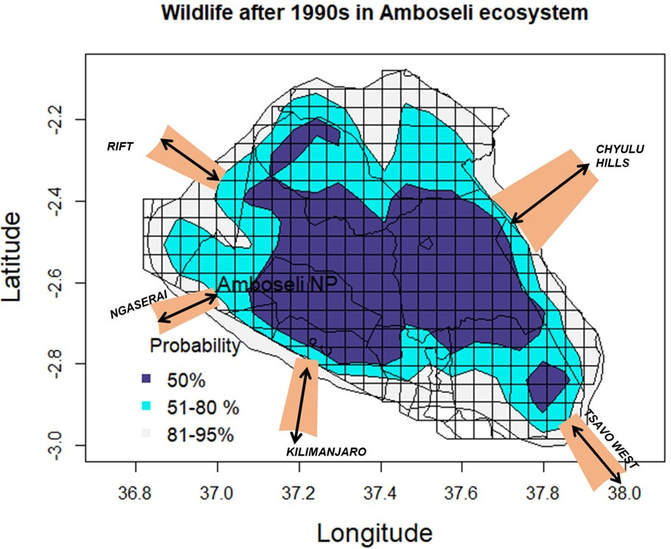
The land use changes call for reducing the Minimum Viable Conservation Area (MVCA) to exclude heavily settled and farmed areas and focusing on the open rangelands still supporting free-ranging wildlife and livestock. The redefined MVCA is given in below.
The Amboseli Ecosystem Management Plan (AEMP) was initiated by ACP and ACC in 2004 to urge the Maasai landowner association to call on Kenya Wildlife Service, other government agencies, conservation organizations, tourism industry and researchers to draw up a conservation plan for the Amboseli ecosystem.
The effort led to the launch a ten year AEMP plan for 2008 to 2018. The aim of ecosystem plan, the first of its kind, was to maintain the viability of the Amboseli migratory wildlife populations.
The plan recognized that pastoral herders also moved seasonally in much the same way as wildlife. With this mind, AEMP defined a Minimum Viable Area for sustaining wildlife and pastoral herds, the threats to the integrity of the ecosystem, and proposed specific mitigation measures.
The renewal of AEMP for a further 10 years is currently underway. ACP has, as in the original planning process, drawn up a detailed report providing the background materials for the new. The report was completed in April and submitted to the planning committee overseeing AEMP 2018-2028.
The ACP report points out that the new plan must take into account the recommendations of the Strategic Environmental Assessment commissioned by the Amboseli Ecosystem Trust and gazetted by the National Environmental Management Authority. The new plan must also include plans for livestock development, rangeland and water management, agriculture, permanent settlements, and allow for urbanization and new enterprises. The plan should also address the changes over the last decade.
The threats detailed in the ACP 2007 report, which have intensified since then, include subdivision, agricultural expansion, water extraction for farms and development, a loss of seasonal pastures, and the growing impact of grazers and browsers on habitat, species diversity, plant production and on livestock and wildlife populations. Poaching has declined to manageable levels since 2008, due to the formation of a large well-managed community ranger force. Human-wildlife conflict has, however, risen sharply to the point of undercutting gains in community-based conservation.
The social, economic and demographic changes underway among the predominantly pastoral community of the Amboseli ecosystem are causing fundamental changes in livelihoods, both out of necessity and choice. In the long run, social and economic development is likely to relieve the pressure on land. Meanwhile, for the many pastoralists who remain herders, land subdivision, sedentarization and a loss of seasonal grazing decreases their mobility, herd sizes and resilience to drought. The same pressures pose severe threats to wildlife and intensify competition between people and wildlife over shrinking space and resources.
The land use changes call for reducing the Minimum Viable Conservation Area (MVCA) to exclude heavily settled and farmed areas and focusing on the open rangelands still supporting free-ranging wildlife and livestock. The redefined MVCA is given in below.