In March, Victor Mose gave a presentation on Spatial and social ecological dynamics of human wildlife interactions at the Institute of Research and Development (IRD) stand at the United Nations Environment Assembly (UNEA-4) in Nairobi. His talk highlighted the need to factor in the social aspects such as human attitudes towards wildlife in modelling their interactions. The presentation is part of ACP’s multidisciplinary approach to understanding the drivers of human wildlife interactions and implication for species conservation and coexistence.
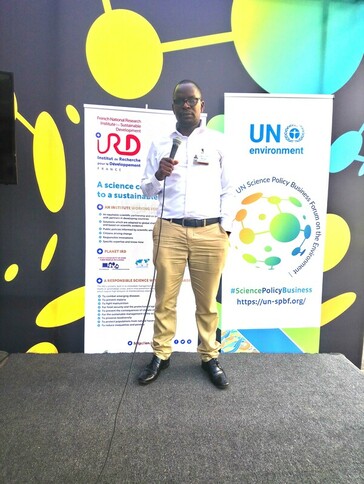
In March, Victor Mose gave a presentation on Spatial and social ecological dynamics of human wildlife interactions at the Institute of Research and Development (IRD) stand at the United Nations Environment Assembly (UNEA-4) in Nairobi. His talk highlighted the need to factor in the social aspects such as human attitudes towards wildlife in modelling their interactions. The presentation is part of ACP’s multidisciplinary approach to understanding the drivers of human wildlife interactions and implication for species conservation and coexistence.
In March, Victor Mose gave a presentation on Spatial and social ecological dynamics of human wildlife interactions at the Institute of Research and Development (IRD) stand at the United Nations Environment Assembly (UNEA-4) in Nairobi. His talk highlighted the need to factor in the social aspects such as human attitudes towards wildlife in modelling their interactions. The presentation is part of ACP’s multidisciplinary approach to understanding the drivers of human wildlife interactions and implication for species conservation and coexistence.
In March, Victor Mose gave a presentation on Spatial and social ecological dynamics of human wildlife interactions at the Institute of Research and Development (IRD) stand at the United Nations Environment Assembly (UNEA-4) in Nairobi. His talk highlighted the need to factor in the social aspects such as human attitudes towards wildlife in modelling their interactions. The presentation is part of ACP’s multidisciplinary approach to understanding the drivers of human wildlife interactions and implication for species conservation and coexistence.