Six decades on from studying the ecology of Amboseli, I wrote in We Alone. How Humans Have Conquered the Planet and Can Also Save It:(2020). “The swamps fed by aquifers from Kilimanjaro gave Amboseli a feeling of permanence, a place where our ancestors coevolved with savanna wildlife over millions of years. I had no illusion that a national park would alone protect the wide-ranging wildlife herds but felt sure at the time that winning Maasai support and securing the seasonal migrations would insulate Amboseli from global changes. I was mistaken. Even as I settled in to Amboseli, the glaciers on Kilimanjaro were shrinking, warmed by the effluent of a distant industrial world”.
The snows of Kilimanjaro framing the magnificent herds of wildlife in Amboseli are a classical African scene. When I set out to study Amboseli in 1967, I was baffled by variety of wildlife coexisting alongside Maasai herders. Oddly, no matter where my search began, whether with geology, soils, hydrology, plants or animals, the path inevitably traced back to Kilimanjaro. The highest solitary mountain in the world dominates Amboseli like a hunched giant stretching fifty miles from end to end and towering 16,000 feet above the dead-flat plains. Were it not for Kilimanjaro’s tumultuous past, Amboseli’s short-grass plains would resemble the flat monotony of Tsavo’s tangled bushland. Amboseli, cradled in the rain shadow of Kilimanjaro attracts the monsoon rains which fall on the forested slopes and bubble up as springs which feed the swamps, promote an extraordinary variety of habitats, and drive the diversity of animal life (extracted from In the Dust of Kilimanjaro, 2021).
Johannes Rebmann in 1849 was the first European to report on the snow-clad Kilimanjaro. The Royal Geographic Society dismissed his report as a hallucination, claiming snow couldn’t possibly exist on the equator. Despite the scientific certitude of the time, snows do fall on the mountain, making it the majestic wonder it is.
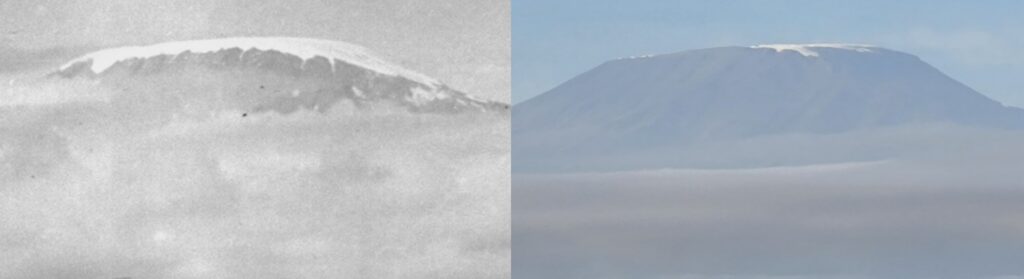
Sadly, Oldoinyo Naipor, the White Mountain of the Maasai, will soon be no more. Where a thick glacial lens stretched along its summit a hundred years ago, spilling over the northern rim of the mountain and stretching down its western flank, only a few isolated ice packs survive today.
Martin Johnson’s captivating 1927 photo of the snows of Kilimanjaro overlooked a cluster of giraffes fronting a dense grove of fever trees. Over the last sixty years I’ve watched the elegant fever trees wither and disappear, along with all but a few giraffes trailing into Amboseli’s swamps to drink.
The melting glaciers of Kilimanjaro have often been cited as the cause of Amboseli’s vanishing woodlands and apparent desiccation as the iconic African fever trees gave way to scrubland.
This is not the case. The loss of woodlands is not due to the melting glaciers but a cascade of ecological changes brought about by the heavy concentration of elephants in Amboseli National Park caused by human activity. There is no ecological link to the glaciers. The roof of Kilimanjaro receives less than 100 millimeters (4 inches) of precipitation a year, making it a high-altitude desert. The melting glaciers evaporate long before reaching the lower slopes.
The spring waters feeding the Amboseli swamps emanate from the pelmet of forests banding the lower slopes of the mountain. Here, more water now flows through the aquifers supplying Amboseli’s springs due to deforestation by farmers. Coupled with flash floods from the growth in permanent settlements surrounding the national park, the swamps have doubled in size in the last few decades. The expanded swamps in turn spurred a large increase in elephants, zebra and wildebeest even as the woodlands, and numbers of giraffe and browsing species shrank.
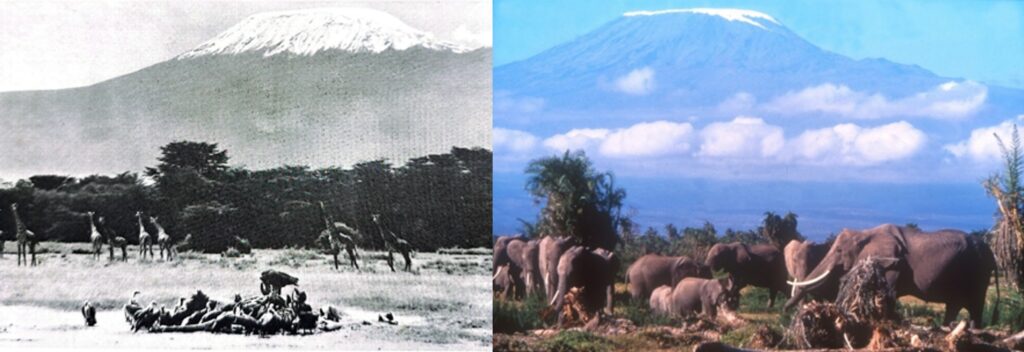
In short, the ecological changes in Amboseli are not caused by the melting glaciers of Kilimanjaro, but do trace to the same source: intensifying human activity.
The melting glaciers of Kilimanjaro tell the far large story of our global impact in warming the earth’s oceans and atmosphere. Amboseli, and all ecosystems worldwide, are no longer insulated from the warming planet we are creating.
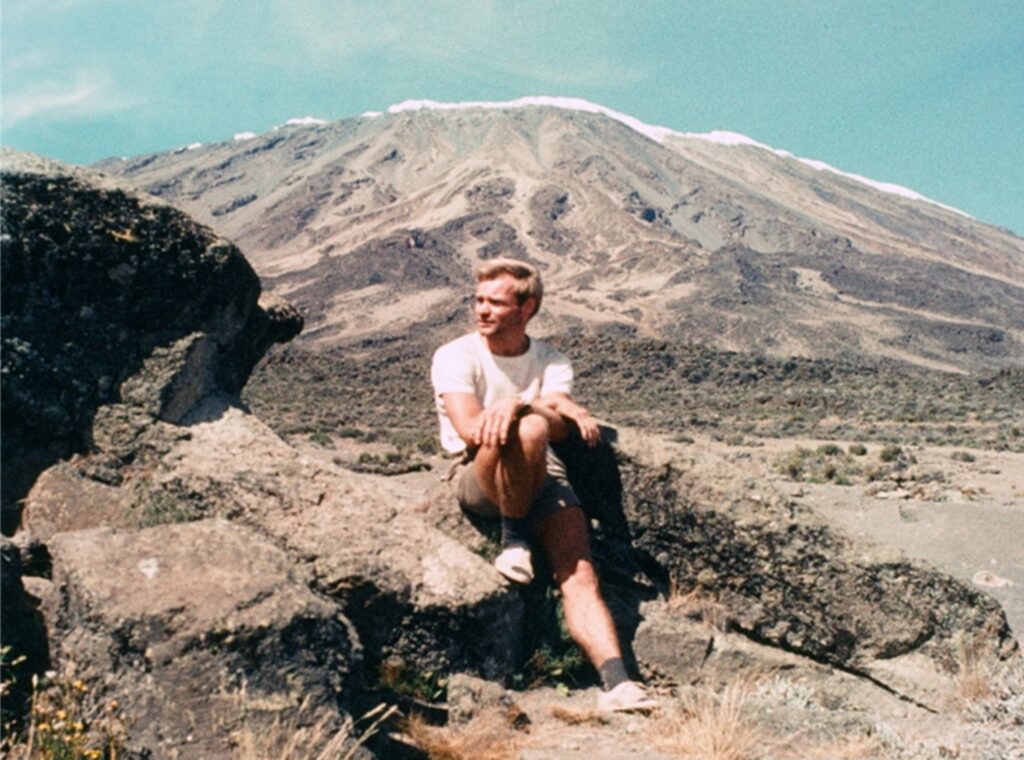
When I climbed Kilimanjaro in 1968, I was mesmerized by the towering glaciers as I summited the roof of Africa, not doubting for a moment fellow climbers would be as thrilled as I was by this Antarctic wonderland on the equator.
I flew over the mountain in a single-engined Cessna 180 ten years later to photograph the glaring whiteness of the glaciers above the verdant greenery of the forest and Amboseli swamps below. By then the ominous warning in the shrinking glaciers enveloping by the expanding black lava mantle was unmistakable. Today, all but five percent of the glaciers remain of those seen by Joseph Thomson in 1883 when he was the first European explorer to reach Amboseli.
On pitching tent in Amboseli in 1967 I would wake on a clear January morning to a rising sun firing up the snows of Kilimanjaro a delicate pink. What a stunning scene it was, watching the teeming herds of wildlife plying across the yellowing plains against the backdrop of the Maasai’s White Mountain. That contrast is lost forever, or at least for the centuries it will take to tamp our green-house emissions, and the snowfalls on Kilimanjaro to recharge the glaciers.
Kilimanjaro reflects the loss of glaciers around the world, from the Arctic to Himalayas, and Antarctic to Andes. The melting snow packs are raising sea levels and causing catastrophic flash floods to villagers down steam. The collapsed glacier sending a tsunami of water which swept away thousands of villagers and hundreds of tourists in Nepal speaks to the volatile climate we are creating. The great migratory wonders of the Serengeti wildebeest, Alaskan caribou and Mongolian gazelle are front-line victims too. The adaptive ebb and flow of wildlife movements to slower climate shifts of the past are unable to respond to the rapid changes, fragmented habitats and physical barriers we have created.
The grandeur of Kilimanjaro draws hundreds of thousands of visitors a year to Kenya and Tanzania. For future visitors the glaciers of Kilimanjaro framing the great herds of wildlife in Amboseli which so enthralled me over the decades will soon be history. The White Mountain will only appear after fresh snowfalls during the rains when Amboseli animals have disappeared on their migrations.
Six decades on from studying the ecology of Amboseli, I wrote in We Alone. How Humans Have Conquered the Planet and Can Also Save It:(2020). “The swamps fed by aquifers from Kilimanjaro gave Amboseli a feeling of permanence, a place where our ancestors coevolved with savanna wildlife over millions of years. I had no illusion that a national park would alone protect the wide-ranging wildlife herds but felt sure at the time that winning Maasai support and securing the seasonal migrations would insulate Amboseli from global changes. I was mistaken. Even as I settled in to Amboseli, the glaciers on Kilimanjaro were shrinking, warmed by the effluent of a distant industrial world”.
The snows of Kilimanjaro framing the magnificent herds of wildlife in Amboseli are a classical African scene. When I set out to study Amboseli in 1967, I was baffled by variety of wildlife coexisting alongside Maasai herders. Oddly, no matter where my search began, whether with geology, soils, hydrology, plants or animals, the path inevitably traced back to Kilimanjaro. The highest solitary mountain in the world dominates Amboseli like a hunched giant stretching fifty miles from end to end and towering 16,000 feet above the dead-flat plains. Were it not for Kilimanjaro’s tumultuous past, Amboseli’s short-grass plains would resemble the flat monotony of Tsavo’s tangled bushland. Amboseli, cradled in the rain shadow of Kilimanjaro attracts the monsoon rains which fall on the forested slopes and bubble up as springs which feed the swamps, promote an extraordinary variety of habitats, and drive the diversity of animal life (extracted from In the Dust of Kilimanjaro, 2021).
Johannes Rebmann in 1849 was the first European to report on the snow-clad Kilimanjaro. The Royal Geographic Society dismissed his report as a hallucination, claiming snow couldn’t possibly exist on the equator. Despite the scientific certitude of the time, snows do fall on the mountain, making it the majestic wonder it is.
Sadly, Oldoinyo Naipor, the White Mountain of the Maasai, will soon be no more. Where a thick glacial lens stretched along its summit a hundred years ago, spilling over the northern rim of the mountain and stretching down its western flank, only a few isolated ice packs survive today.
Martin Johnson’s captivating 1927 photo of the snows of Kilimanjaro overlooked a cluster of giraffes fronting a dense grove of fever trees. Over the last sixty years I’ve watched the elegant fever trees wither and disappear, along with all but a few giraffes trailing into Amboseli’s swamps to drink.
The melting glaciers of Kilimanjaro have often been cited as the cause of Amboseli’s vanishing woodlands and apparent desiccation as the iconic African fever trees gave way to scrubland.
This is not the case. The loss of woodlands is not due to the melting glaciers but a cascade of ecological changes brought about by the heavy concentration of elephants in Amboseli National Park caused by human activity. There is no ecological link to the glaciers. The roof of Kilimanjaro receives less than 100 millimeters (4 inches) of precipitation a year, making it a high-altitude desert. The melting glaciers evaporate long before reaching the lower slopes.
The spring waters feeding the Amboseli swamps emanate from the pelmet of forests banding the lower slopes of the mountain. Here, more water now flows through the aquifers supplying Amboseli’s springs due to deforestation by farmers. Coupled with flash floods from the growth in permanent settlements surrounding the national park, the swamps have doubled in size in the last few decades. The expanded swamps in turn spurred a large increase in elephants, zebra and wildebeest even as the woodlands, and numbers of giraffe and browsing species shrank.
In short, the ecological changes in Amboseli are not caused by the melting glaciers of Kilimanjaro, but do trace to the same source: intensifying human activity.
The melting glaciers of Kilimanjaro tell the far large story of our global impact in warming the earth’s oceans and atmosphere. Amboseli, and all ecosystems worldwide, are no longer insulated from the warming planet we are creating.
When I climbed Kilimanjaro in 1968, I was mesmerized by the towering glaciers as I summited the roof of Africa, not doubting for a moment fellow climbers would be as thrilled as I was by this Antarctic wonderland on the equator.
I flew over the mountain in a single-engined Cessna 180 ten years later to photograph the glaring whiteness of the glaciers above the verdant greenery of the forest and Amboseli swamps below. By then the ominous warning in the shrinking glaciers enveloping by the expanding black lava mantle was unmistakable. Today, all but five percent of the glaciers remain of those seen by Joseph Thomson in 1883 when he was the first European explorer to reach Amboseli.
On pitching tent in Amboseli in 1967 I would wake on a clear January morning to a rising sun firing up the snows of Kilimanjaro a delicate pink. What a stunning scene it was, watching the teeming herds of wildlife plying across the yellowing plains against the backdrop of the Maasai’s White Mountain. That contrast is lost forever, or at least for the centuries it will take to tamp our green-house emissions, and the snowfalls on Kilimanjaro to recharge the glaciers.
Kilimanjaro reflects the loss of glaciers around the world, from the Arctic to Himalayas, and Antarctic to Andes. The melting snow packs are raising sea levels and causing catastrophic flash floods to villagers down steam. The collapsed glacier sending a tsunami of water which swept away thousands of villagers and hundreds of tourists in Nepal speaks to the volatile climate we are creating. The great migratory wonders of the Serengeti wildebeest, Alaskan caribou and Mongolian gazelle are front-line victims too. The adaptive ebb and flow of wildlife movements to slower climate shifts of the past are unable to respond to the rapid changes, fragmented habitats and physical barriers we have created.
The grandeur of Kilimanjaro draws hundreds of thousands of visitors a year to Kenya and Tanzania. For future visitors the glaciers of Kilimanjaro framing the great herds of wildlife in Amboseli which so enthralled me over the decades will soon be history. The White Mountain will only appear after fresh snowfalls during the rains when Amboseli animals have disappeared on their migrations.
Six decades on from studying the ecology of Amboseli, I wrote in We Alone. How Humans Have Conquered the Planet and Can Also Save It:(2020). “The swamps fed by aquifers from Kilimanjaro gave Amboseli a feeling of permanence, a place where our ancestors coevolved with savanna wildlife over millions of years. I had no illusion that a national park would alone protect the wide-ranging wildlife herds but felt sure at the time that winning Maasai support and securing the seasonal migrations would insulate Amboseli from global changes. I was mistaken. Even as I settled in to Amboseli, the glaciers on Kilimanjaro were shrinking, warmed by the effluent of a distant industrial world”.
The snows of Kilimanjaro framing the magnificent herds of wildlife in Amboseli are a classical African scene. When I set out to study Amboseli in 1967, I was baffled by variety of wildlife coexisting alongside Maasai herders. Oddly, no matter where my search began, whether with geology, soils, hydrology, plants or animals, the path inevitably traced back to Kilimanjaro. The highest solitary mountain in the world dominates Amboseli like a hunched giant stretching fifty miles from end to end and towering 16,000 feet above the dead-flat plains. Were it not for Kilimanjaro’s tumultuous past, Amboseli’s short-grass plains would resemble the flat monotony of Tsavo’s tangled bushland. Amboseli, cradled in the rain shadow of Kilimanjaro attracts the monsoon rains which fall on the forested slopes and bubble up as springs which feed the swamps, promote an extraordinary variety of habitats, and drive the diversity of animal life (extracted from In the Dust of Kilimanjaro, 2021).
Johannes Rebmann in 1849 was the first European to report on the snow-clad Kilimanjaro. The Royal Geographic Society dismissed his report as a hallucination, claiming snow couldn’t possibly exist on the equator. Despite the scientific certitude of the time, snows do fall on the mountain, making it the majestic wonder it is.
Sadly, Oldoinyo Naipor, the White Mountain of the Maasai, will soon be no more. Where a thick glacial lens stretched along its summit a hundred years ago, spilling over the northern rim of the mountain and stretching down its western flank, only a few isolated ice packs survive today.
Martin Johnson’s captivating 1927 photo of the snows of Kilimanjaro overlooked a cluster of giraffes fronting a dense grove of fever trees. Over the last sixty years I’ve watched the elegant fever trees wither and disappear, along with all but a few giraffes trailing into Amboseli’s swamps to drink.
The melting glaciers of Kilimanjaro have often been cited as the cause of Amboseli’s vanishing woodlands and apparent desiccation as the iconic African fever trees gave way to scrubland.
This is not the case. The loss of woodlands is not due to the melting glaciers but a cascade of ecological changes brought about by the heavy concentration of elephants in Amboseli National Park caused by human activity. There is no ecological link to the glaciers. The roof of Kilimanjaro receives less than 100 millimeters (4 inches) of precipitation a year, making it a high-altitude desert. The melting glaciers evaporate long before reaching the lower slopes.
The spring waters feeding the Amboseli swamps emanate from the pelmet of forests banding the lower slopes of the mountain. Here, more water now flows through the aquifers supplying Amboseli’s springs due to deforestation by farmers. Coupled with flash floods from the growth in permanent settlements surrounding the national park, the swamps have doubled in size in the last few decades. The expanded swamps in turn spurred a large increase in elephants, zebra and wildebeest even as the woodlands, and numbers of giraffe and browsing species shrank.
In short, the ecological changes in Amboseli are not caused by the melting glaciers of Kilimanjaro, but do trace to the same source: intensifying human activity.
The melting glaciers of Kilimanjaro tell the far large story of our global impact in warming the earth’s oceans and atmosphere. Amboseli, and all ecosystems worldwide, are no longer insulated from the warming planet we are creating.
When I climbed Kilimanjaro in 1968, I was mesmerized by the towering glaciers as I summited the roof of Africa, not doubting for a moment fellow climbers would be as thrilled as I was by this Antarctic wonderland on the equator.
I flew over the mountain in a single-engined Cessna 180 ten years later to photograph the glaring whiteness of the glaciers above the verdant greenery of the forest and Amboseli swamps below. By then the ominous warning in the shrinking glaciers enveloping by the expanding black lava mantle was unmistakable. Today, all but five percent of the glaciers remain of those seen by Joseph Thomson in 1883 when he was the first European explorer to reach Amboseli.
On pitching tent in Amboseli in 1967 I would wake on a clear January morning to a rising sun firing up the snows of Kilimanjaro a delicate pink. What a stunning scene it was, watching the teeming herds of wildlife plying across the yellowing plains against the backdrop of the Maasai’s White Mountain. That contrast is lost forever, or at least for the centuries it will take to tamp our green-house emissions, and the snowfalls on Kilimanjaro to recharge the glaciers.
Kilimanjaro reflects the loss of glaciers around the world, from the Arctic to Himalayas, and Antarctic to Andes. The melting snow packs are raising sea levels and causing catastrophic flash floods to villagers down steam. The collapsed glacier sending a tsunami of water which swept away thousands of villagers and hundreds of tourists in Nepal speaks to the volatile climate we are creating. The great migratory wonders of the Serengeti wildebeest, Alaskan caribou and Mongolian gazelle are front-line victims too. The adaptive ebb and flow of wildlife movements to slower climate shifts of the past are unable to respond to the rapid changes, fragmented habitats and physical barriers we have created.
The grandeur of Kilimanjaro draws hundreds of thousands of visitors a year to Kenya and Tanzania. For future visitors the glaciers of Kilimanjaro framing the great herds of wildlife in Amboseli which so enthralled me over the decades will soon be history. The White Mountain will only appear after fresh snowfalls during the rains when Amboseli animals have disappeared on their migrations.
Six decades on from studying the ecology of Amboseli, I wrote in We Alone. How Humans Have Conquered the Planet and Can Also Save It:(2020). “The swamps fed by aquifers from Kilimanjaro gave Amboseli a feeling of permanence, a place where our ancestors coevolved with savanna wildlife over millions of years. I had no illusion that a national park would alone protect the wide-ranging wildlife herds but felt sure at the time that winning Maasai support and securing the seasonal migrations would insulate Amboseli from global changes. I was mistaken. Even as I settled in to Amboseli, the glaciers on Kilimanjaro were shrinking, warmed by the effluent of a distant industrial world”.
The snows of Kilimanjaro framing the magnificent herds of wildlife in Amboseli are a classical African scene. When I set out to study Amboseli in 1967, I was baffled by variety of wildlife coexisting alongside Maasai herders. Oddly, no matter where my search began, whether with geology, soils, hydrology, plants or animals, the path inevitably traced back to Kilimanjaro. The highest solitary mountain in the world dominates Amboseli like a hunched giant stretching fifty miles from end to end and towering 16,000 feet above the dead-flat plains. Were it not for Kilimanjaro’s tumultuous past, Amboseli’s short-grass plains would resemble the flat monotony of Tsavo’s tangled bushland. Amboseli, cradled in the rain shadow of Kilimanjaro attracts the monsoon rains which fall on the forested slopes and bubble up as springs which feed the swamps, promote an extraordinary variety of habitats, and drive the diversity of animal life (extracted from In the Dust of Kilimanjaro, 2021).
Johannes Rebmann in 1849 was the first European to report on the snow-clad Kilimanjaro. The Royal Geographic Society dismissed his report as a hallucination, claiming snow couldn’t possibly exist on the equator. Despite the scientific certitude of the time, snows do fall on the mountain, making it the majestic wonder it is.
Sadly, Oldoinyo Naipor, the White Mountain of the Maasai, will soon be no more. Where a thick glacial lens stretched along its summit a hundred years ago, spilling over the northern rim of the mountain and stretching down its western flank, only a few isolated ice packs survive today.
Martin Johnson’s captivating 1927 photo of the snows of Kilimanjaro overlooked a cluster of giraffes fronting a dense grove of fever trees. Over the last sixty years I’ve watched the elegant fever trees wither and disappear, along with all but a few giraffes trailing into Amboseli’s swamps to drink.
The melting glaciers of Kilimanjaro have often been cited as the cause of Amboseli’s vanishing woodlands and apparent desiccation as the iconic African fever trees gave way to scrubland.
This is not the case. The loss of woodlands is not due to the melting glaciers but a cascade of ecological changes brought about by the heavy concentration of elephants in Amboseli National Park caused by human activity. There is no ecological link to the glaciers. The roof of Kilimanjaro receives less than 100 millimeters (4 inches) of precipitation a year, making it a high-altitude desert. The melting glaciers evaporate long before reaching the lower slopes.
The spring waters feeding the Amboseli swamps emanate from the pelmet of forests banding the lower slopes of the mountain. Here, more water now flows through the aquifers supplying Amboseli’s springs due to deforestation by farmers. Coupled with flash floods from the growth in permanent settlements surrounding the national park, the swamps have doubled in size in the last few decades. The expanded swamps in turn spurred a large increase in elephants, zebra and wildebeest even as the woodlands, and numbers of giraffe and browsing species shrank.
In short, the ecological changes in Amboseli are not caused by the melting glaciers of Kilimanjaro, but do trace to the same source: intensifying human activity.
The melting glaciers of Kilimanjaro tell the far large story of our global impact in warming the earth’s oceans and atmosphere. Amboseli, and all ecosystems worldwide, are no longer insulated from the warming planet we are creating.
When I climbed Kilimanjaro in 1968, I was mesmerized by the towering glaciers as I summited the roof of Africa, not doubting for a moment fellow climbers would be as thrilled as I was by this Antarctic wonderland on the equator.
I flew over the mountain in a single-engined Cessna 180 ten years later to photograph the glaring whiteness of the glaciers above the verdant greenery of the forest and Amboseli swamps below. By then the ominous warning in the shrinking glaciers enveloping by the expanding black lava mantle was unmistakable. Today, all but five percent of the glaciers remain of those seen by Joseph Thomson in 1883 when he was the first European explorer to reach Amboseli.
On pitching tent in Amboseli in 1967 I would wake on a clear January morning to a rising sun firing up the snows of Kilimanjaro a delicate pink. What a stunning scene it was, watching the teeming herds of wildlife plying across the yellowing plains against the backdrop of the Maasai’s White Mountain. That contrast is lost forever, or at least for the centuries it will take to tamp our green-house emissions, and the snowfalls on Kilimanjaro to recharge the glaciers.
Kilimanjaro reflects the loss of glaciers around the world, from the Arctic to Himalayas, and Antarctic to Andes. The melting snow packs are raising sea levels and causing catastrophic flash floods to villagers down steam. The collapsed glacier sending a tsunami of water which swept away thousands of villagers and hundreds of tourists in Nepal speaks to the volatile climate we are creating. The great migratory wonders of the Serengeti wildebeest, Alaskan caribou and Mongolian gazelle are front-line victims too. The adaptive ebb and flow of wildlife movements to slower climate shifts of the past are unable to respond to the rapid changes, fragmented habitats and physical barriers we have created.
The grandeur of Kilimanjaro draws hundreds of thousands of visitors a year to Kenya and Tanzania. For future visitors the glaciers of Kilimanjaro framing the great herds of wildlife in Amboseli which so enthralled me over the decades will soon be history. The White Mountain will only appear after fresh snowfalls during the rains when Amboseli animals have disappeared on their migrations.