We anticipated a severe dry season in June 2021 when the long rains were paltry across the Amboseli region and severe in northern and eastern Kenya. It was soon apparent from our ground monitoring that Amboseli faced severe grazing shortages in the eastern portion of the ecosystem. By January the extreme pasture shortages had spread well to the east towards the Chyulu Hills. Anticipating a severe drought in early 2022, the Amboseli Conservation Program commissioned the Department of Resource Surveys and Remote Sensing (DRSRS), and the Flight Training Centre at Wilson Nairobi, to conduct an aerial count of the Amboseli ecosystem in January 2022.
By late December it was apparent that Amboseli had been invaded by a huge influx of cattle from Tanzania, Matapatu, the Rift Valley and other places to the west and south where the rains had failed. The influx quickly reduced the sparse forage around Amboseli and moved east towards the Chyulu Hills where the rains were moderately good. By mid-January cattle were emaciated, most especially those from Tanzania, and the weaker animals were dying. We planned our count to capture the extent of the invasion and issue a forecast of heavy anticipated livestock deaths and plunging market prices.
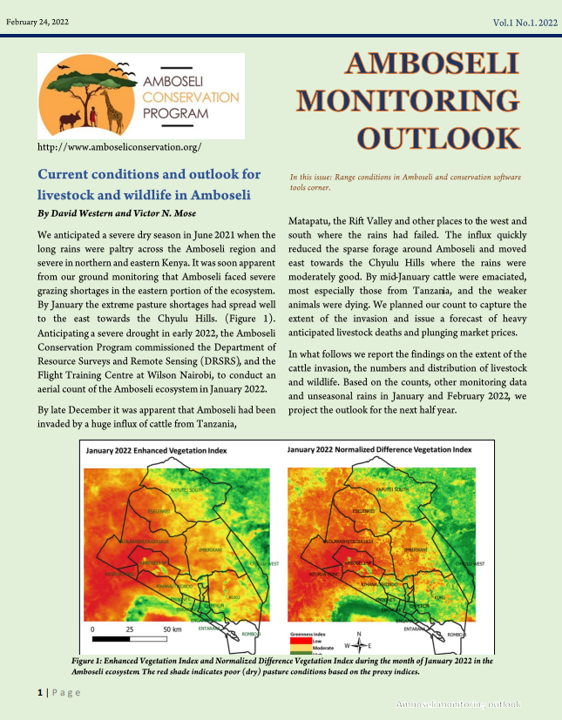
In what follows we report the findings on the extent of the cattle invasion, the numbers and distribution of livestock and wildlife in the first bulletin by the Amboseli Conservation Program. Based on the counts, other monitoring data and unseasonal rains in January and February 2022, we project the outlook for the next half year.
Download the first Amboseli Monitoring Outlook Bulletin below.
We anticipated a severe dry season in June 2021 when the long rains were paltry across the Amboseli region and severe in northern and eastern Kenya. It was soon apparent from our ground monitoring that Amboseli faced severe grazing shortages in the eastern portion of the ecosystem. By January the extreme pasture shortages had spread well to the east towards the Chyulu Hills. Anticipating a severe drought in early 2022, the Amboseli Conservation Program commissioned the Department of Resource Surveys and Remote Sensing (DRSRS), and the Flight Training Centre at Wilson Nairobi, to conduct an aerial count of the Amboseli ecosystem in January 2022.
By late December it was apparent that Amboseli had been invaded by a huge influx of cattle from Tanzania, Matapatu, the Rift Valley and other places to the west and south where the rains had failed. The influx quickly reduced the sparse forage around Amboseli and moved east towards the Chyulu Hills where the rains were moderately good. By mid-January cattle were emaciated, most especially those from Tanzania, and the weaker animals were dying. We planned our count to capture the extent of the invasion and issue a forecast of heavy anticipated livestock deaths and plunging market prices.
In what follows we report the findings on the extent of the cattle invasion, the numbers and distribution of livestock and wildlife in the first bulletin by the Amboseli Conservation Program. Based on the counts, other monitoring data and unseasonal rains in January and February 2022, we project the outlook for the next half year.
Download the first Amboseli Monitoring Outlook Bulletin below.
We anticipated a severe dry season in June 2021 when the long rains were paltry across the Amboseli region and severe in northern and eastern Kenya. It was soon apparent from our ground monitoring that Amboseli faced severe grazing shortages in the eastern portion of the ecosystem. By January the extreme pasture shortages had spread well to the east towards the Chyulu Hills. Anticipating a severe drought in early 2022, the Amboseli Conservation Program commissioned the Department of Resource Surveys and Remote Sensing (DRSRS), and the Flight Training Centre at Wilson Nairobi, to conduct an aerial count of the Amboseli ecosystem in January 2022.
By late December it was apparent that Amboseli had been invaded by a huge influx of cattle from Tanzania, Matapatu, the Rift Valley and other places to the west and south where the rains had failed. The influx quickly reduced the sparse forage around Amboseli and moved east towards the Chyulu Hills where the rains were moderately good. By mid-January cattle were emaciated, most especially those from Tanzania, and the weaker animals were dying. We planned our count to capture the extent of the invasion and issue a forecast of heavy anticipated livestock deaths and plunging market prices.
In what follows we report the findings on the extent of the cattle invasion, the numbers and distribution of livestock and wildlife in the first bulletin by the Amboseli Conservation Program. Based on the counts, other monitoring data and unseasonal rains in January and February 2022, we project the outlook for the next half year.
Download the first Amboseli Monitoring Outlook Bulletin below.
We anticipated a severe dry season in June 2021 when the long rains were paltry across the Amboseli region and severe in northern and eastern Kenya. It was soon apparent from our ground monitoring that Amboseli faced severe grazing shortages in the eastern portion of the ecosystem. By January the extreme pasture shortages had spread well to the east towards the Chyulu Hills. Anticipating a severe drought in early 2022, the Amboseli Conservation Program commissioned the Department of Resource Surveys and Remote Sensing (DRSRS), and the Flight Training Centre at Wilson Nairobi, to conduct an aerial count of the Amboseli ecosystem in January 2022.
By late December it was apparent that Amboseli had been invaded by a huge influx of cattle from Tanzania, Matapatu, the Rift Valley and other places to the west and south where the rains had failed. The influx quickly reduced the sparse forage around Amboseli and moved east towards the Chyulu Hills where the rains were moderately good. By mid-January cattle were emaciated, most especially those from Tanzania, and the weaker animals were dying. We planned our count to capture the extent of the invasion and issue a forecast of heavy anticipated livestock deaths and plunging market prices.
In what follows we report the findings on the extent of the cattle invasion, the numbers and distribution of livestock and wildlife in the first bulletin by the Amboseli Conservation Program. Based on the counts, other monitoring data and unseasonal rains in January and February 2022, we project the outlook for the next half year.
Download the first Amboseli Monitoring Outlook Bulletin below.