
By Victor N. Mose, David Western and the ACP team

The livestock market in eastern Kajiado has steadily recovered after the near collapse in 2009 owing to the debilitating drought that led to losses of cattle, sheep, goats and donkeys. Prices fell below 1,000 Kenya shillings for a bull too weak to walk and surged to 90,000 Kenya shillings with the drought breaks (Figure 1). Amboseli Conservation Program monitors  livestock  market prices  on a monthly basis and is in the process of modelling economic losses due to droughts and the gains when herders sell off their livestock early enough before  periods of extreme  forage shortfall.
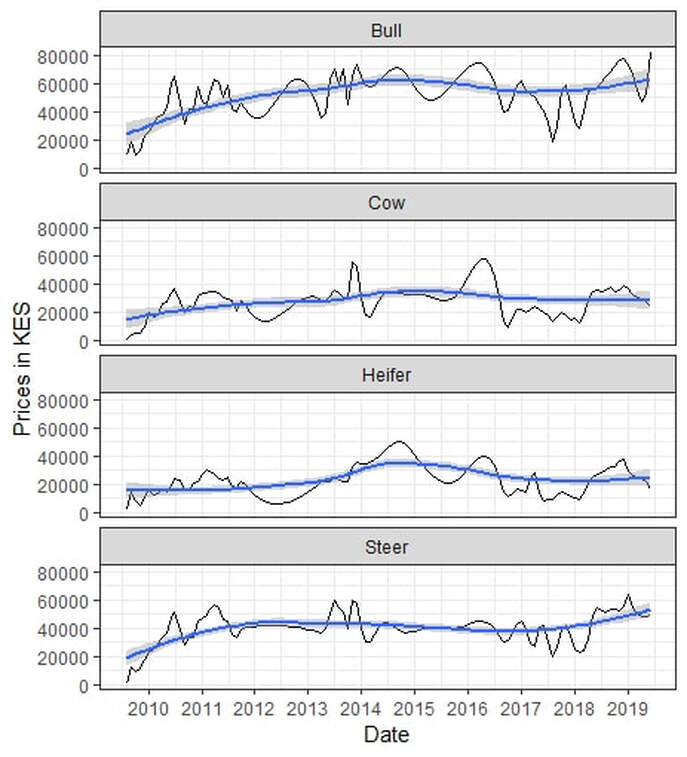
Figure 1: Average livestock market prices in eastern Kajiado showing a steady recovery after the 2009 drought and fluctuations with subsequent dry periods.

A calibration of livestock prices based on monthly  data collected in the ecosystem from 2009 to 2019 shows that  the  average prices for bulls in 2009 were in the red (Figure 2) falling 80.1 percent below the maximum expected market price. The market recovered steadily up to  2014 with arrival of widespread rainfall  and oscillated with seasonality thereafter.
The early warning model can guide herders on when to sell off their livestock  based on forage conditions and market forces, while estimating economic losses  due to extreme drought.
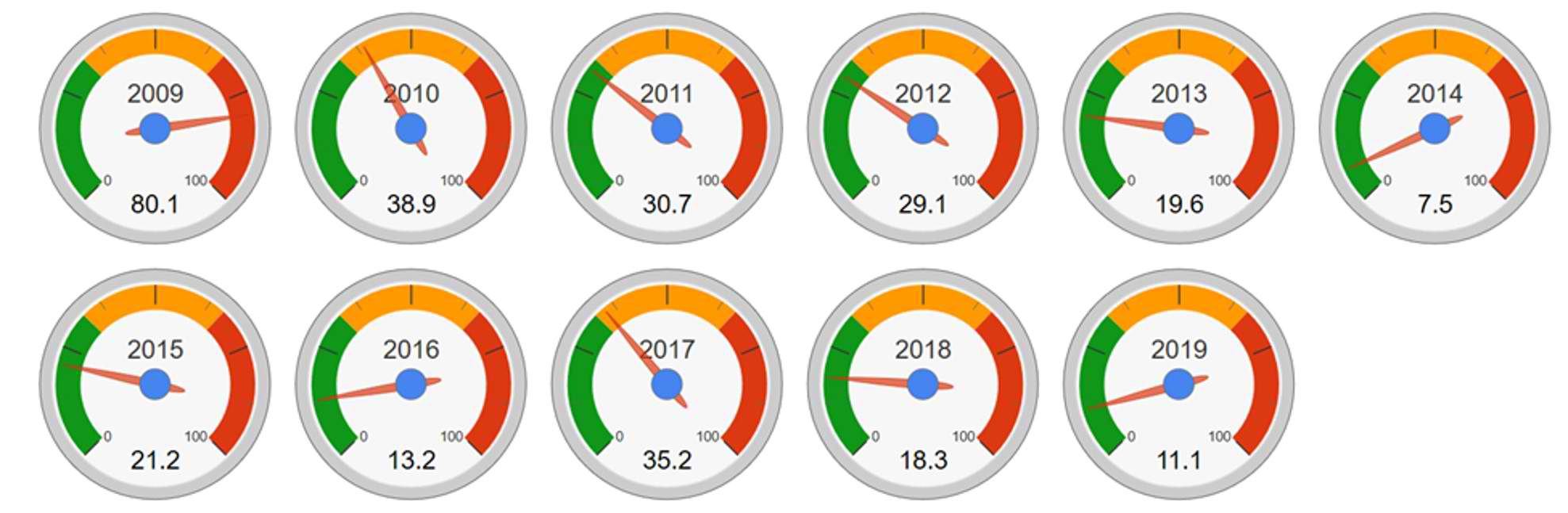
Figure 2: Price gauges showing average bull price index in percentages below the maximum price ever recorded. The prices, in the red during the 2009 drought, fell 80 percent below the maximum before recovering steadily up to 2014.
Figure 3: Annual variations of the livestock prices from 2009 to 2019.

By Victor N. Mose

May 12, 2026

Staff at the Embassy of Kenya in Vienna were treated to an “elephant show” following Angela Mumbi’s presentation

By Victor N. Mose

April 4, 2026

The MOSAIC meeting in Montpellier focused on practical solutions for shared environmental and health challenges

By Victor N. Mose

March 18, 2026

Project MOSAIC has launched community-driven One Health Clubs in Amboseli to strengthen local action on resources.

An analysis of livestock price fluctuations with droughts in eastern Kajiado

Authored by : Victor N. Mose, David Western and the ACP team
Posted on January 31, 2020

The livestock market in eastern Kajiado has steadily recovered after the near collapse in 2009 owing to the debilitating drought that led to losses of cattle, sheep, goats and donkeys. Prices fell below 1,000 Kenya shillings for a bull too weak to walk and surged to 90,000 Kenya shillings with the drought breaks (Figure 1). Amboseli Conservation Program monitors  livestock  market prices  on a monthly basis and is in the process of modelling economic losses due to droughts and the gains when herders sell off their livestock early enough before  periods of extreme  forage shortfall.

Figure 1: Average livestock market prices in eastern Kajiado showing a steady recovery after the 2009 drought and fluctuations with subsequent dry periods.

A calibration of livestock prices based on monthly  data collected in the ecosystem from 2009 to 2019 shows that  the  average prices for bulls in 2009 were in the red (Figure 2) falling 80.1 percent below the maximum expected market price. The market recovered steadily up to  2014 with arrival of widespread rainfall  and oscillated with seasonality thereafter.
The early warning model can guide herders on when to sell off their livestock  based on forage conditions and market forces, while estimating economic losses  due to extreme drought.
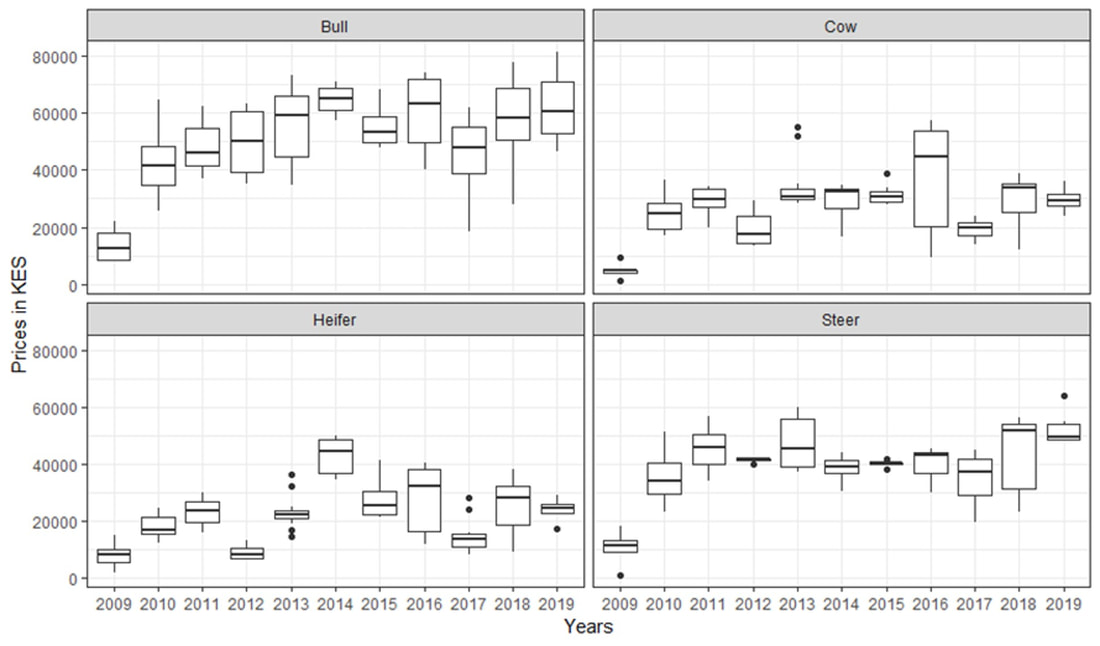
Figure 2: Price gauges showing average bull price index in percentages below the maximum price ever recorded. The prices, in the red during the 2009 drought, fell 80 percent below the maximum before recovering steadily up to 2014.
Figure 3: Annual variations of the livestock prices from 2009 to 2019.

By Victor N. Mose, David Western and the ACP team

The livestock market in eastern Kajiado has steadily recovered after the near collapse in 2009 owing to the debilitating drought that led to losses of cattle, sheep, goats and donkeys. Prices fell below 1,000 Kenya shillings for a bull too weak to walk and surged to 90,000 Kenya shillings with the drought breaks (Figure 1). Amboseli Conservation Program monitors  livestock  market prices  on a monthly basis and is in the process of modelling economic losses due to droughts and the gains when herders sell off their livestock early enough before  periods of extreme  forage shortfall.

Figure 1: Average livestock market prices in eastern Kajiado showing a steady recovery after the 2009 drought and fluctuations with subsequent dry periods.

A calibration of livestock prices based on monthly  data collected in the ecosystem from 2009 to 2019 shows that  the  average prices for bulls in 2009 were in the red (Figure 2) falling 80.1 percent below the maximum expected market price. The market recovered steadily up to  2014 with arrival of widespread rainfall  and oscillated with seasonality thereafter.
The early warning model can guide herders on when to sell off their livestock  based on forage conditions and market forces, while estimating economic losses  due to extreme drought.

Figure 2: Price gauges showing average bull price index in percentages below the maximum price ever recorded. The prices, in the red during the 2009 drought, fell 80 percent below the maximum before recovering steadily up to 2014.
Figure 3: Annual variations of the livestock prices from 2009 to 2019.

By Victor N. Mose

May 12, 2026

Staff at the Embassy of Kenya in Vienna were treated to an “elephant show” following Angela Mumbi’s presentation

By Victor N. Mose

April 4, 2026

The MOSAIC meeting in Montpellier focused on practical solutions for shared environmental and health challenges

By Victor N. Mose

March 18, 2026

Project MOSAIC has launched community-driven One Health Clubs in Amboseli to strengthen local action on resources.

Posted on January 31, 2020

By Victor N. Mose, David Western and the ACP team

The livestock market in eastern Kajiado has steadily recovered after the near collapse in 2009 owing to the debilitating drought that led to losses of cattle, sheep, goats and donkeys. Prices fell below 1,000 Kenya shillings for a bull too weak to walk and surged to 90,000 Kenya shillings with the drought breaks (Figure 1). Amboseli Conservation Program monitors  livestock  market prices  on a monthly basis and is in the process of modelling economic losses due to droughts and the gains when herders sell off their livestock early enough before  periods of extreme  forage shortfall.

Figure 1: Average livestock market prices in eastern Kajiado showing a steady recovery after the 2009 drought and fluctuations with subsequent dry periods.

A calibration of livestock prices based on monthly  data collected in the ecosystem from 2009 to 2019 shows that  the  average prices for bulls in 2009 were in the red (Figure 2) falling 80.1 percent below the maximum expected market price. The market recovered steadily up to  2014 with arrival of widespread rainfall  and oscillated with seasonality thereafter.
The early warning model can guide herders on when to sell off their livestock  based on forage conditions and market forces, while estimating economic losses  due to extreme drought.

Figure 2: Price gauges showing average bull price index in percentages below the maximum price ever recorded. The prices, in the red during the 2009 drought, fell 80 percent below the maximum before recovering steadily up to 2014.
Figure 3: Annual variations of the livestock prices from 2009 to 2019.

Recent Posts

By David Western, Victor N. Mose* , David Maitumo, Winfridah Kemunto, Sakimba Kimiti, Immaculate Ombongi, Samuel Lekanaiya, Paul Kasaine and Sunte Kimiti

May 20, 2026

As a result of the unseasonal rains in January to April, conditions in Amboseli have changed from a severe drought

By Victor N. Mose

May 12, 2026

Staff at the Embassy of Kenya in Vienna were treated to an “elephant show” following Angela Mumbi’s presentation

By Victor N. Mose

April 4, 2026

The MOSAIC meeting in Montpellier focused on practical solutions for shared environmental and health challenges

By Victor N. Mose

March 18, 2026

Project MOSAIC has launched community-driven One Health Clubs in Amboseli to strengthen local action on resources.

By David Western

February 25, 2026

The greatest wildlife spectacles on earth are the migrations of large mammals and birds.

By David Western

December 5, 2025

Short rains failed in Oct to Nov 2025 and heavy post-drought stocking pushed pastures from green to red.

By David Western

November 27, 2025

The handing back of Amboseli National Park to Kajiado County management on 8th November 2025

By ACP Team

July 26, 2025

Our Amboseli Conservation Program Outlook Report gives the state of pastures, livestock, and wildlife health.

By Victor Mose

June 9, 2025

Horizontal learning, where local communities and scientists co-design research, remains a central pillar of Mosaic

By ACP Team

May 6, 2025

We are delighted to present the inaugural issue of Eseriani, a new magazine dedicated to exploring well-being

Contact Us

Amboseli Conservation Program
P.O Box 15289-00509 or 62844-00200
Nairobi, Kenya.

Tel/Fax: +254 20 891360 / 891751
Email: acc@acc.or.ke