
Harsh times ahead for herders as the rains fail
Herders face an extreme drought in Amboseli in the coming dry season, perhaps as bad as the 2009 drought when over half the cattle died, milk yields dried up and sale prices fell to rock bottom. The dire outlook is forecast by ACP’s monitoring and herder’s own assessments. The cause of the dire outlook is a combination of a mounting grazing pressure over the last few years, an influx of over 150,000 cattle in from Matapatu, Kaputei and Tanzania in January and February, and poor long rains in April and May.
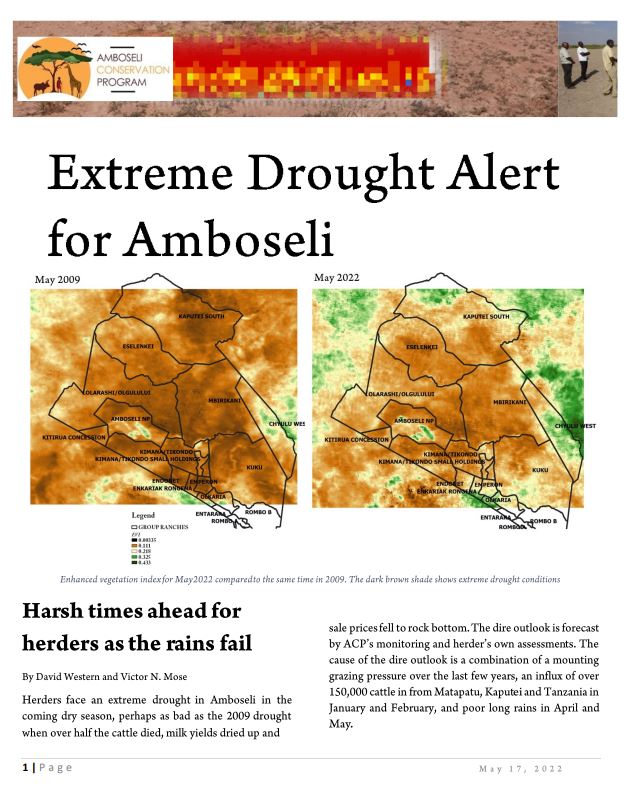
The satellite data shown below compares the conditions before the large livestock die-off after the long rains in May of 2009 with May of 2022. All group ranches in the Amboseli region face dire drought in the coming months.
Grazing pressure for April 2022 is at peak across the group ranches, hitting 100% in Kimana, Imbirikani, Olgulului and sections of Eselengei. The Chyulu Hills, usually a drought refuge, have already reached 98%. Despite the heavy rains of 2017 to 2021 being the wettest run of years in decades, the continuous grazing pressure since the beginning of the year due to the influx of cattle has reduced pasture levels close to those of the 2009 drought.
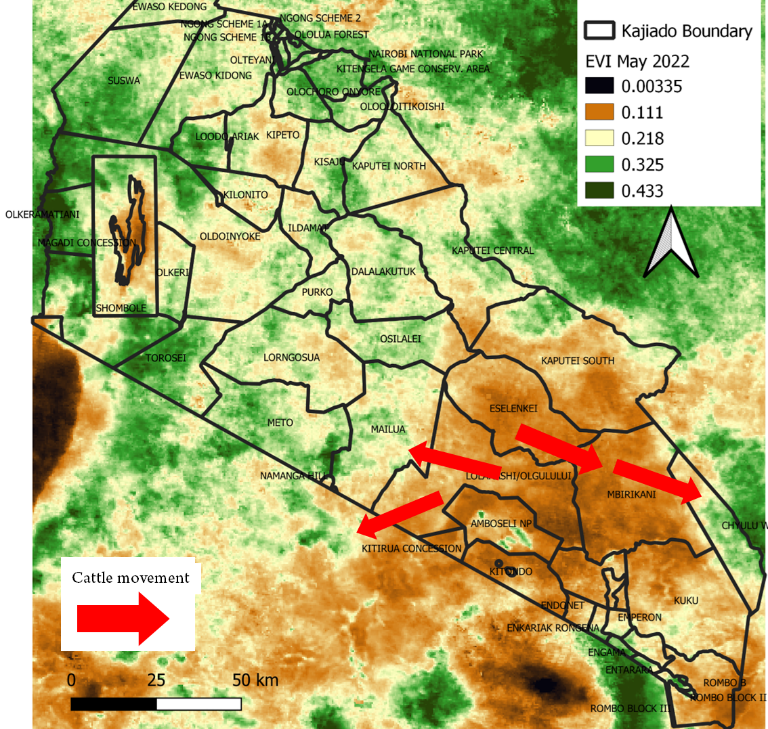
In response to the grave pasture conditions on the Amboseli group ranches, herders are driving their cattle to Matapatu / Mailua and into northern Tanzania, areas where the May 2022 satellite image shows some pastures still remain.
In a further warning of the hard months ahead, livestock prices are already dropping to drought levels due to the excess numbers entering the market. The extreme drought warning calls for herders to sell excess animals as soon as they can before the prices fall further, and to buy in hay to feed their maintenance herd through the drought.
Unless excess stocks are removed soon, large numbers of livestock will die of starvation, further damaging the pastures and resulting in poor recovery even if the short rains are good.
Download Extreme Drought Alert for Amboseli below.
Harsh times ahead for herders as the rains fail
Herders face an extreme drought in Amboseli in the coming dry season, perhaps as bad as the 2009 drought when over half the cattle died, milk yields dried up and sale prices fell to rock bottom. The dire outlook is forecast by ACP’s monitoring and herder’s own assessments. The cause of the dire outlook is a combination of a mounting grazing pressure over the last few years, an influx of over 150,000 cattle in from Matapatu, Kaputei and Tanzania in January and February, and poor long rains in April and May.
The satellite data shown below compares the conditions before the large livestock die-off after the long rains in May of 2009 with May of 2022. All group ranches in the Amboseli region face dire drought in the coming months.
Grazing pressure for April 2022 is at peak across the group ranches, hitting 100% in Kimana, Imbirikani, Olgulului and sections of Eselengei. The Chyulu Hills, usually a drought refuge, have already reached 98%. Despite the heavy rains of 2017 to 2021 being the wettest run of years in decades, the continuous grazing pressure since the beginning of the year due to the influx of cattle has reduced pasture levels close to those of the 2009 drought.
In response to the grave pasture conditions on the Amboseli group ranches, herders are driving their cattle to Matapatu / Mailua and into northern Tanzania, areas where the May 2022 satellite image shows some pastures still remain.
In a further warning of the hard months ahead, livestock prices are already dropping to drought levels due to the excess numbers entering the market. The extreme drought warning calls for herders to sell excess animals as soon as they can before the prices fall further, and to buy in hay to feed their maintenance herd through the drought.
Unless excess stocks are removed soon, large numbers of livestock will die of starvation, further damaging the pastures and resulting in poor recovery even if the short rains are good.
Download Extreme Drought Alert for Amboseli below.
Harsh times ahead for herders as the rains fail
Herders face an extreme drought in Amboseli in the coming dry season, perhaps as bad as the 2009 drought when over half the cattle died, milk yields dried up and sale prices fell to rock bottom. The dire outlook is forecast by ACP’s monitoring and herder’s own assessments. The cause of the dire outlook is a combination of a mounting grazing pressure over the last few years, an influx of over 150,000 cattle in from Matapatu, Kaputei and Tanzania in January and February, and poor long rains in April and May.
The satellite data shown below compares the conditions before the large livestock die-off after the long rains in May of 2009 with May of 2022. All group ranches in the Amboseli region face dire drought in the coming months.
Grazing pressure for April 2022 is at peak across the group ranches, hitting 100% in Kimana, Imbirikani, Olgulului and sections of Eselengei. The Chyulu Hills, usually a drought refuge, have already reached 98%. Despite the heavy rains of 2017 to 2021 being the wettest run of years in decades, the continuous grazing pressure since the beginning of the year due to the influx of cattle has reduced pasture levels close to those of the 2009 drought.
In response to the grave pasture conditions on the Amboseli group ranches, herders are driving their cattle to Matapatu / Mailua and into northern Tanzania, areas where the May 2022 satellite image shows some pastures still remain.
In a further warning of the hard months ahead, livestock prices are already dropping to drought levels due to the excess numbers entering the market. The extreme drought warning calls for herders to sell excess animals as soon as they can before the prices fall further, and to buy in hay to feed their maintenance herd through the drought.
Unless excess stocks are removed soon, large numbers of livestock will die of starvation, further damaging the pastures and resulting in poor recovery even if the short rains are good.
Download Extreme Drought Alert for Amboseli below.
Harsh times ahead for herders as the rains fail
Herders face an extreme drought in Amboseli in the coming dry season, perhaps as bad as the 2009 drought when over half the cattle died, milk yields dried up and sale prices fell to rock bottom. The dire outlook is forecast by ACP’s monitoring and herder’s own assessments. The cause of the dire outlook is a combination of a mounting grazing pressure over the last few years, an influx of over 150,000 cattle in from Matapatu, Kaputei and Tanzania in January and February, and poor long rains in April and May.
The satellite data shown below compares the conditions before the large livestock die-off after the long rains in May of 2009 with May of 2022. All group ranches in the Amboseli region face dire drought in the coming months.
Grazing pressure for April 2022 is at peak across the group ranches, hitting 100% in Kimana, Imbirikani, Olgulului and sections of Eselengei. The Chyulu Hills, usually a drought refuge, have already reached 98%. Despite the heavy rains of 2017 to 2021 being the wettest run of years in decades, the continuous grazing pressure since the beginning of the year due to the influx of cattle has reduced pasture levels close to those of the 2009 drought.
In response to the grave pasture conditions on the Amboseli group ranches, herders are driving their cattle to Matapatu / Mailua and into northern Tanzania, areas where the May 2022 satellite image shows some pastures still remain.
In a further warning of the hard months ahead, livestock prices are already dropping to drought levels due to the excess numbers entering the market. The extreme drought warning calls for herders to sell excess animals as soon as they can before the prices fall further, and to buy in hay to feed their maintenance herd through the drought.
Unless excess stocks are removed soon, large numbers of livestock will die of starvation, further damaging the pastures and resulting in poor recovery even if the short rains are good.
Download Extreme Drought Alert for Amboseli below.