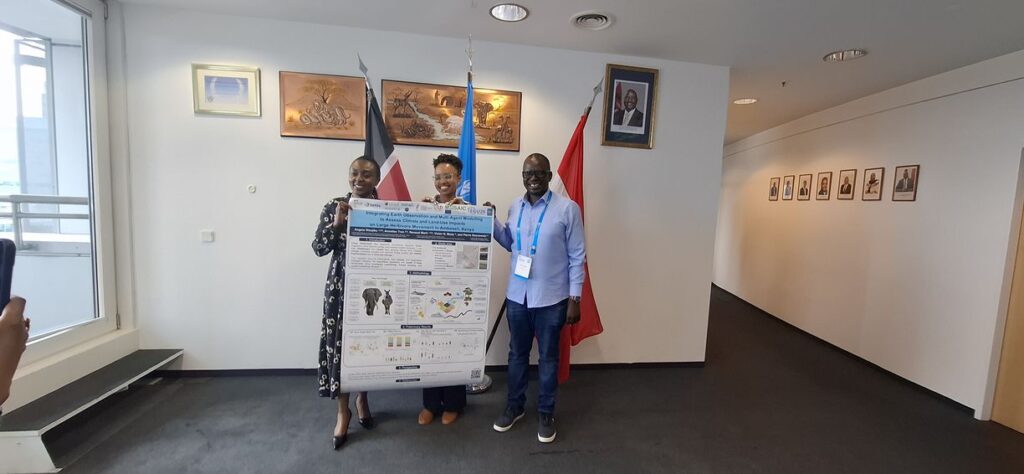
Staff at the Embassy of Kenya in Vienna were treated to an “elephant show” following Angela Mumbi’s presentation on large mammal movement modelling in the Amboseli ecosystem in East Africa. Angela, a PhD student in the European Union funded MOSAIC** project, had earlier that morning presented to thousands of participants attending the European Geosciences Union (EGU) Congress held at the Austria Center Vienna (ACV), located near the Embassy building.
Incidentally, the staff at the Embassy had been engaged in a discussion on promoting tourism over a brainstorming lunch that featured elephants among Kenya’s many attractions. Our visit briefly interrupted the discussion before naturally blending into it as we explained the elephant modelling work and the MOSAIC project in general. The Deputy Head of Mission, Ambassador Valarie Rugene, together with her team, keenly followed the multispecies modelling work in the East African cross border landscape, driven by rainfall, pasture resources, settlement expansion, among other complexities. The session later evolved into a lively discussion, with questions on ways to improve the model and better communicate such technical work to non-technical audiences as part of broader promotional efforts.
Ambassador Rugene further reiterated the need to introduce such multidisciplinary work early enough to students, even at the high school level, to encourage them to think beyond domain-specific careers and appreciate broader interdisciplinary applications akin to the formulation of the MOSAIC project. She also linked this approach to the model that has been used to promote Technical Vocational Education and Training (TVET) programs in Kenya. On further modelling work, she noted that it would be important to include predators such as lions in the multispecies model, given their role in shaping dispersal dynamics. The discussion appeared to briefly capture the attention of the two heraldic “lions” standing on solemn national duty atop Kenya’s Coat of Arms, neatly mounted in the boardroom. For a fleeting imaginary moment, the pair seemed ready to abandon their diplomatic post for a savannah chase of the zebras displayed on Angela’s poster. We later gifted the team in Vienna the poster for display to future visitors.
Meanwhile, the MOSAIC team presenting that morning at the Planetary Health session highlighted the project’s work in East Africa and the Amazon region. Victor Mose presented on how One Health Community Clubs in Amboseli are helping to promote planetary health through the co-identification of research problems and co- modelling with local communities in addressing challenges such as extreme droughts and floods.
He further highlighted how Artificial Intelligence (AI) tools are being used in a participatory manner to identify drainage pathways for excess floodwater in the Amboseli basin.
Other presentations during the session included one by Sara Mobsite, a postdoctoral researcher in the MOSAIC project, who presented on deep learning techniques and their applications in the Amazon study site. Pierre Sosnowski and Aneta Afelt also presented posters at the EGU 2026 Assembly.
Cross-Border Context in Europe
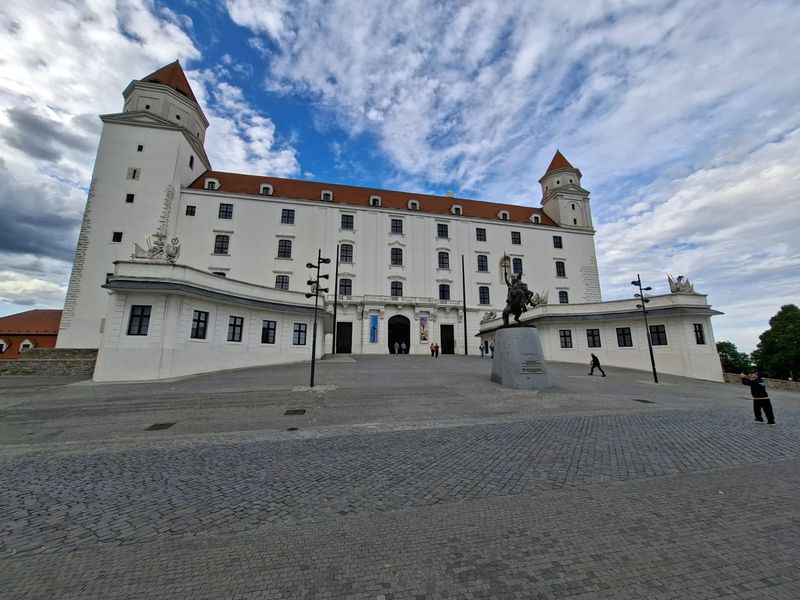
The MOSAIC project largely focuses on cross-border dynamics in the Amazon region and East Africa. While attending activities in Vienna, participants also had an opportunity to experience another cross-border setting in Europe through a visit to nearby Bratislava, the capital city of Slovakia, located only about an hour from Vienna.
For many first-time visitors, one of the striking observations was the ease of movement within the Schengen Area, where crossing national borders can feel almost seamless. Participants noted the convenience of shared transport systems, common currency use across many countries, and ticketing options that allow travel across different public transport networks within the region.
Beyond mobility, the visit also offered a glimpse into the rich cultural and historical connections that continue to shape life across European border regions.
Tripoint
While the majestic Amazon River naturally defines parts of the MOSAIC triple- border study area linking Colombia, Brazil, and Peru, the European tripoint between Austria, Hungary, and Slovakia presents a quieter contrast. Near the village of Deutsch Jahrndorf in Austria, according to our guide, a simple picnic table with three benches symbolically marks the meeting point of the three countries.
Read Full Report : Here
Staff at the Embassy of Kenya in Vienna were treated to an “elephant show” following Angela Mumbi’s presentation on large mammal movement modelling in the Amboseli ecosystem in East Africa. Angela, a PhD student in the European Union funded MOSAIC** project, had earlier that morning presented to thousands of participants attending the European Geosciences Union (EGU) Congress held at the Austria Center Vienna (ACV), located near the Embassy building.
Incidentally, the staff at the Embassy had been engaged in a discussion on promoting tourism over a brainstorming lunch that featured elephants among Kenya’s many attractions. Our visit briefly interrupted the discussion before naturally blending into it as we explained the elephant modelling work and the MOSAIC project in general. The Deputy Head of Mission, Ambassador Valarie Rugene, together with her team, keenly followed the multispecies modelling work in the East African cross border landscape, driven by rainfall, pasture resources, settlement expansion, among other complexities. The session later evolved into a lively discussion, with questions on ways to improve the model and better communicate such technical work to non-technical audiences as part of broader promotional efforts.
Ambassador Rugene further reiterated the need to introduce such multidisciplinary work early enough to students, even at the high school level, to encourage them to think beyond domain-specific careers and appreciate broader interdisciplinary applications akin to the formulation of the MOSAIC project. She also linked this approach to the model that has been used to promote Technical Vocational Education and Training (TVET) programs in Kenya. On further modelling work, she noted that it would be important to include predators such as lions in the multispecies model, given their role in shaping dispersal dynamics. The discussion appeared to briefly capture the attention of the two heraldic “lions” standing on solemn national duty atop Kenya’s Coat of Arms, neatly mounted in the boardroom. For a fleeting imaginary moment, the pair seemed ready to abandon their diplomatic post for a savannah chase of the zebras displayed on Angela’s poster. We later gifted the team in Vienna the poster for display to future visitors.
Meanwhile, the MOSAIC team presenting that morning at the Planetary Health session highlighted the project’s work in East Africa and the Amazon region. Victor Mose presented on how One Health Community Clubs in Amboseli are helping to promote planetary health through the co-identification of research problems and co- modelling with local communities in addressing challenges such as extreme droughts and floods.
He further highlighted how Artificial Intelligence (AI) tools are being used in a participatory manner to identify drainage pathways for excess floodwater in the Amboseli basin.
Other presentations during the session included one by Sara Mobsite, a postdoctoral researcher in the MOSAIC project, who presented on deep learning techniques and their applications in the Amazon study site. Pierre Sosnowski and Aneta Afelt also presented posters at the EGU 2026 Assembly.
Cross-Border Context in Europe
The MOSAIC project largely focuses on cross-border dynamics in the Amazon region and East Africa. While attending activities in Vienna, participants also had an opportunity to experience another cross-border setting in Europe through a visit to nearby Bratislava, the capital city of Slovakia, located only about an hour from Vienna.
For many first-time visitors, one of the striking observations was the ease of movement within the Schengen Area, where crossing national borders can feel almost seamless. Participants noted the convenience of shared transport systems, common currency use across many countries, and ticketing options that allow travel across different public transport networks within the region.
Beyond mobility, the visit also offered a glimpse into the rich cultural and historical connections that continue to shape life across European border regions.
Tripoint
While the majestic Amazon River naturally defines parts of the MOSAIC triple- border study area linking Colombia, Brazil, and Peru, the European tripoint between Austria, Hungary, and Slovakia presents a quieter contrast. Near the village of Deutsch Jahrndorf in Austria, according to our guide, a simple picnic table with three benches symbolically marks the meeting point of the three countries.
Read Full Report : Here
Staff at the Embassy of Kenya in Vienna were treated to an “elephant show” following Angela Mumbi’s presentation on large mammal movement modelling in the Amboseli ecosystem in East Africa. Angela, a PhD student in the European Union funded MOSAIC** project, had earlier that morning presented to thousands of participants attending the European Geosciences Union (EGU) Congress held at the Austria Center Vienna (ACV), located near the Embassy building.
Incidentally, the staff at the Embassy had been engaged in a discussion on promoting tourism over a brainstorming lunch that featured elephants among Kenya’s many attractions. Our visit briefly interrupted the discussion before naturally blending into it as we explained the elephant modelling work and the MOSAIC project in general. The Deputy Head of Mission, Ambassador Valarie Rugene, together with her team, keenly followed the multispecies modelling work in the East African cross border landscape, driven by rainfall, pasture resources, settlement expansion, among other complexities. The session later evolved into a lively discussion, with questions on ways to improve the model and better communicate such technical work to non-technical audiences as part of broader promotional efforts.
Ambassador Rugene further reiterated the need to introduce such multidisciplinary work early enough to students, even at the high school level, to encourage them to think beyond domain-specific careers and appreciate broader interdisciplinary applications akin to the formulation of the MOSAIC project. She also linked this approach to the model that has been used to promote Technical Vocational Education and Training (TVET) programs in Kenya. On further modelling work, she noted that it would be important to include predators such as lions in the multispecies model, given their role in shaping dispersal dynamics. The discussion appeared to briefly capture the attention of the two heraldic “lions” standing on solemn national duty atop Kenya’s Coat of Arms, neatly mounted in the boardroom. For a fleeting imaginary moment, the pair seemed ready to abandon their diplomatic post for a savannah chase of the zebras displayed on Angela’s poster. We later gifted the team in Vienna the poster for display to future visitors.
Meanwhile, the MOSAIC team presenting that morning at the Planetary Health session highlighted the project’s work in East Africa and the Amazon region. Victor Mose presented on how One Health Community Clubs in Amboseli are helping to promote planetary health through the co-identification of research problems and co- modelling with local communities in addressing challenges such as extreme droughts and floods.
He further highlighted how Artificial Intelligence (AI) tools are being used in a participatory manner to identify drainage pathways for excess floodwater in the Amboseli basin.
Other presentations during the session included one by Sara Mobsite, a postdoctoral researcher in the MOSAIC project, who presented on deep learning techniques and their applications in the Amazon study site. Pierre Sosnowski and Aneta Afelt also presented posters at the EGU 2026 Assembly.
Cross-Border Context in Europe
The MOSAIC project largely focuses on cross-border dynamics in the Amazon region and East Africa. While attending activities in Vienna, participants also had an opportunity to experience another cross-border setting in Europe through a visit to nearby Bratislava, the capital city of Slovakia, located only about an hour from Vienna.
For many first-time visitors, one of the striking observations was the ease of movement within the Schengen Area, where crossing national borders can feel almost seamless. Participants noted the convenience of shared transport systems, common currency use across many countries, and ticketing options that allow travel across different public transport networks within the region.
Beyond mobility, the visit also offered a glimpse into the rich cultural and historical connections that continue to shape life across European border regions.
Tripoint
While the majestic Amazon River naturally defines parts of the MOSAIC triple- border study area linking Colombia, Brazil, and Peru, the European tripoint between Austria, Hungary, and Slovakia presents a quieter contrast. Near the village of Deutsch Jahrndorf in Austria, according to our guide, a simple picnic table with three benches symbolically marks the meeting point of the three countries.
Read Full Report : Here
Staff at the Embassy of Kenya in Vienna were treated to an “elephant show” following Angela Mumbi’s presentation on large mammal movement modelling in the Amboseli ecosystem in East Africa. Angela, a PhD student in the European Union funded MOSAIC** project, had earlier that morning presented to thousands of participants attending the European Geosciences Union (EGU) Congress held at the Austria Center Vienna (ACV), located near the Embassy building.
Incidentally, the staff at the Embassy had been engaged in a discussion on promoting tourism over a brainstorming lunch that featured elephants among Kenya’s many attractions. Our visit briefly interrupted the discussion before naturally blending into it as we explained the elephant modelling work and the MOSAIC project in general. The Deputy Head of Mission, Ambassador Valarie Rugene, together with her team, keenly followed the multispecies modelling work in the East African cross border landscape, driven by rainfall, pasture resources, settlement expansion, among other complexities. The session later evolved into a lively discussion, with questions on ways to improve the model and better communicate such technical work to non-technical audiences as part of broader promotional efforts.
Ambassador Rugene further reiterated the need to introduce such multidisciplinary work early enough to students, even at the high school level, to encourage them to think beyond domain-specific careers and appreciate broader interdisciplinary applications akin to the formulation of the MOSAIC project. She also linked this approach to the model that has been used to promote Technical Vocational Education and Training (TVET) programs in Kenya. On further modelling work, she noted that it would be important to include predators such as lions in the multispecies model, given their role in shaping dispersal dynamics. The discussion appeared to briefly capture the attention of the two heraldic “lions” standing on solemn national duty atop Kenya’s Coat of Arms, neatly mounted in the boardroom. For a fleeting imaginary moment, the pair seemed ready to abandon their diplomatic post for a savannah chase of the zebras displayed on Angela’s poster. We later gifted the team in Vienna the poster for display to future visitors.
Meanwhile, the MOSAIC team presenting that morning at the Planetary Health session highlighted the project’s work in East Africa and the Amazon region. Victor Mose presented on how One Health Community Clubs in Amboseli are helping to promote planetary health through the co-identification of research problems and co- modelling with local communities in addressing challenges such as extreme droughts and floods.
He further highlighted how Artificial Intelligence (AI) tools are being used in a participatory manner to identify drainage pathways for excess floodwater in the Amboseli basin.
Other presentations during the session included one by Sara Mobsite, a postdoctoral researcher in the MOSAIC project, who presented on deep learning techniques and their applications in the Amazon study site. Pierre Sosnowski and Aneta Afelt also presented posters at the EGU 2026 Assembly.
Cross-Border Context in Europe
The MOSAIC project largely focuses on cross-border dynamics in the Amazon region and East Africa. While attending activities in Vienna, participants also had an opportunity to experience another cross-border setting in Europe through a visit to nearby Bratislava, the capital city of Slovakia, located only about an hour from Vienna.
For many first-time visitors, one of the striking observations was the ease of movement within the Schengen Area, where crossing national borders can feel almost seamless. Participants noted the convenience of shared transport systems, common currency use across many countries, and ticketing options that allow travel across different public transport networks within the region.
Beyond mobility, the visit also offered a glimpse into the rich cultural and historical connections that continue to shape life across European border regions.
Tripoint
While the majestic Amazon River naturally defines parts of the MOSAIC triple- border study area linking Colombia, Brazil, and Peru, the European tripoint between Austria, Hungary, and Slovakia presents a quieter contrast. Near the village of Deutsch Jahrndorf in Austria, according to our guide, a simple picnic table with three benches symbolically marks the meeting point of the three countries.
Read Full Report : Here