
Milk yields are dwindling, livestock prices are falling to rock bottom, and animals are in such poor condition that few herders can sell them at acceptable prices. This is the picture in Amboseli as the effects of drought are being felt across the country. Mothers are concerned about a lack of milk for their school-age children, and absent fathers are desperate to save their cattle which are out searching the remaining pastures far from their homesteads.
Data from the Amboseli Conservation Program (ACP) on livestock prices, milk yields, and body condition scores show the rapidly declining trends. Gourds are empty, the body condition of the remaining lactating cows is far below average, and market prices for a heifer are fetching Kenya shillings 5,000 or less. The numbers of animals up for sale is now so large, many herds are unable to find any market at all.
Following the release of an ACP drought alert in May, stakeholders in the Amboseli ecosystem, led by the Amboseli Ecosystem Trust (AET), convened in Kimana to guide the community on immediate drought mitigation measures and preparedness for extreme drought in the coming months. A separate report on the deliberations during the meeting will be published shortly.
Graphs of recent livestock market prices, milk yields, and body condition scores collected by the ACP locally-recruited monitoring team are presented below.
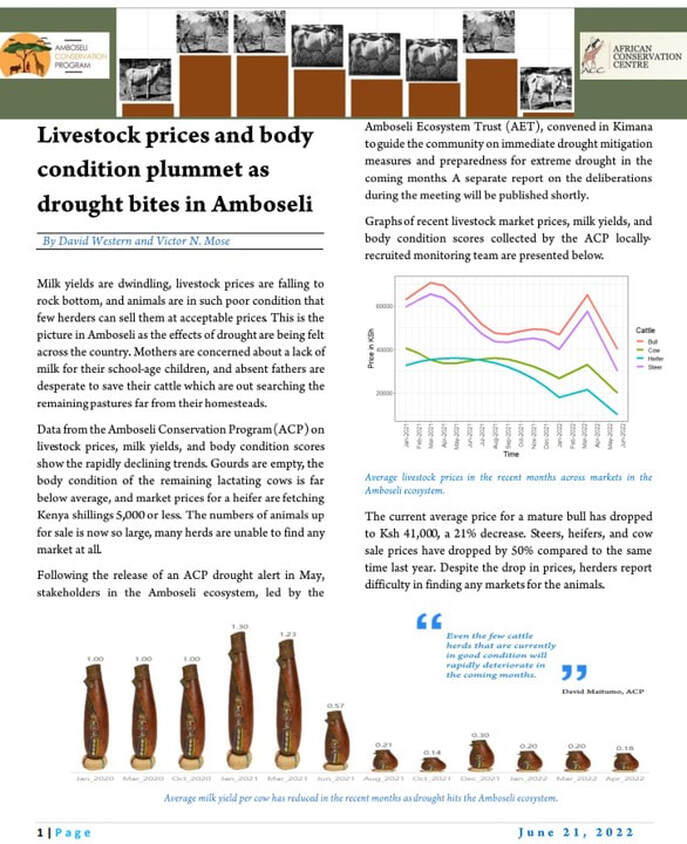
he current average price for a mature bull has dropped to Ksh 41,000, a 21% decrease. Steers, heifers, and cow sale prices have dropped by 50% compared to the same time last year. Despite the drop in prices, herders report difficulty in finding any markets for the animals.
The graph tracking lactating cow body scores and milk yields at the homesteads shows conditions falling fast to the 2009 catastrophic drought levels. Herders at the Kimana meeting were told to brace for harsh times in the coming months and plan ahead. ACP has modelled economic losses due to droughts and the gains made when herders sell off their livestock before extreme forage shortfalls. The results will be posted shortly. The early warning model guides herders on when to sell livestock based on forage conditions and market forces to avoid extreme economic losses. The information will be presented using simple open-source dashboards for ease of understanding by local herders.
Milk yields are dwindling, livestock prices are falling to rock bottom, and animals are in such poor condition that few herders can sell them at acceptable prices. This is the picture in Amboseli as the effects of drought are being felt across the country. Mothers are concerned about a lack of milk for their school-age children, and absent fathers are desperate to save their cattle which are out searching the remaining pastures far from their homesteads.
Data from the Amboseli Conservation Program (ACP) on livestock prices, milk yields, and body condition scores show the rapidly declining trends. Gourds are empty, the body condition of the remaining lactating cows is far below average, and market prices for a heifer are fetching Kenya shillings 5,000 or less. The numbers of animals up for sale is now so large, many herds are unable to find any market at all.
Following the release of an ACP drought alert in May, stakeholders in the Amboseli ecosystem, led by the Amboseli Ecosystem Trust (AET), convened in Kimana to guide the community on immediate drought mitigation measures and preparedness for extreme drought in the coming months. A separate report on the deliberations during the meeting will be published shortly.
Graphs of recent livestock market prices, milk yields, and body condition scores collected by the ACP locally-recruited monitoring team are presented below.
he current average price for a mature bull has dropped to Ksh 41,000, a 21% decrease. Steers, heifers, and cow sale prices have dropped by 50% compared to the same time last year. Despite the drop in prices, herders report difficulty in finding any markets for the animals.
The graph tracking lactating cow body scores and milk yields at the homesteads shows conditions falling fast to the 2009 catastrophic drought levels. Herders at the Kimana meeting were told to brace for harsh times in the coming months and plan ahead. ACP has modelled economic losses due to droughts and the gains made when herders sell off their livestock before extreme forage shortfalls. The results will be posted shortly. The early warning model guides herders on when to sell livestock based on forage conditions and market forces to avoid extreme economic losses. The information will be presented using simple open-source dashboards for ease of understanding by local herders.
Milk yields are dwindling, livestock prices are falling to rock bottom, and animals are in such poor condition that few herders can sell them at acceptable prices. This is the picture in Amboseli as the effects of drought are being felt across the country. Mothers are concerned about a lack of milk for their school-age children, and absent fathers are desperate to save their cattle which are out searching the remaining pastures far from their homesteads.
Data from the Amboseli Conservation Program (ACP) on livestock prices, milk yields, and body condition scores show the rapidly declining trends. Gourds are empty, the body condition of the remaining lactating cows is far below average, and market prices for a heifer are fetching Kenya shillings 5,000 or less. The numbers of animals up for sale is now so large, many herds are unable to find any market at all.
Following the release of an ACP drought alert in May, stakeholders in the Amboseli ecosystem, led by the Amboseli Ecosystem Trust (AET), convened in Kimana to guide the community on immediate drought mitigation measures and preparedness for extreme drought in the coming months. A separate report on the deliberations during the meeting will be published shortly.
Graphs of recent livestock market prices, milk yields, and body condition scores collected by the ACP locally-recruited monitoring team are presented below.
he current average price for a mature bull has dropped to Ksh 41,000, a 21% decrease. Steers, heifers, and cow sale prices have dropped by 50% compared to the same time last year. Despite the drop in prices, herders report difficulty in finding any markets for the animals.
The graph tracking lactating cow body scores and milk yields at the homesteads shows conditions falling fast to the 2009 catastrophic drought levels. Herders at the Kimana meeting were told to brace for harsh times in the coming months and plan ahead. ACP has modelled economic losses due to droughts and the gains made when herders sell off their livestock before extreme forage shortfalls. The results will be posted shortly. The early warning model guides herders on when to sell livestock based on forage conditions and market forces to avoid extreme economic losses. The information will be presented using simple open-source dashboards for ease of understanding by local herders.
Milk yields are dwindling, livestock prices are falling to rock bottom, and animals are in such poor condition that few herders can sell them at acceptable prices. This is the picture in Amboseli as the effects of drought are being felt across the country. Mothers are concerned about a lack of milk for their school-age children, and absent fathers are desperate to save their cattle which are out searching the remaining pastures far from their homesteads.
Data from the Amboseli Conservation Program (ACP) on livestock prices, milk yields, and body condition scores show the rapidly declining trends. Gourds are empty, the body condition of the remaining lactating cows is far below average, and market prices for a heifer are fetching Kenya shillings 5,000 or less. The numbers of animals up for sale is now so large, many herds are unable to find any market at all.
Following the release of an ACP drought alert in May, stakeholders in the Amboseli ecosystem, led by the Amboseli Ecosystem Trust (AET), convened in Kimana to guide the community on immediate drought mitigation measures and preparedness for extreme drought in the coming months. A separate report on the deliberations during the meeting will be published shortly.
Graphs of recent livestock market prices, milk yields, and body condition scores collected by the ACP locally-recruited monitoring team are presented below.
he current average price for a mature bull has dropped to Ksh 41,000, a 21% decrease. Steers, heifers, and cow sale prices have dropped by 50% compared to the same time last year. Despite the drop in prices, herders report difficulty in finding any markets for the animals.
The graph tracking lactating cow body scores and milk yields at the homesteads shows conditions falling fast to the 2009 catastrophic drought levels. Herders at the Kimana meeting were told to brace for harsh times in the coming months and plan ahead. ACP has modelled economic losses due to droughts and the gains made when herders sell off their livestock before extreme forage shortfalls. The results will be posted shortly. The early warning model guides herders on when to sell livestock based on forage conditions and market forces to avoid extreme economic losses. The information will be presented using simple open-source dashboards for ease of understanding by local herders.