
By David Western

The spatial contraction of the Amboseli ecosystem is worrying, based on an analysis of the long-term counts dating back to 1973. Victor Mose, who attended a special workshop on spatial modeling in ecology held in Birmingham UK in June (watch video below), has been developing visualization tools to distill and illustrate the extent of spatial change in species distributions.
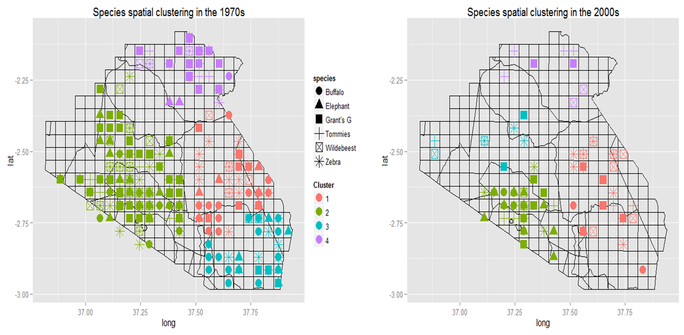
Figure 1. Spatial clustering of keystone species in the 1970s and 2000s in the Amboseli ecosystem

The provisional maps (Figure 1) are based on six key species. The results illustrate a strong contraction in the spatial spread and richness of species in the four main clusters of wildlife populations identified by spatial clustering techniques. Regaining the spatial connections is  important for the health and richness of the ungulate and carnivore populations will be the focus of land use plans ACP will draw up with AET in the coming few months.

By Victor N. Mose

August 10, 2026

Amboseli Conservation Program (ACP) statisticians this week took Bayesian inference back 1 million years.

By Dr. David Jonah Western

August 5, 2026

Sixteen elephants have died in Amboseli in just a few weeks, alarming conservationists and the Maasai community

By David Western, Victor N. Mose*, David Maitumo, Winfridah Kemunto, Sakimba Kimiti, Immaculate Ombongi, Samuel Lekanaiya, Paul Kasaine and Sunte Kimiti

July 31, 2026

The latest Amboseli Ecosystem Outlook Report combines perspectives from local herders and livestock traders

Long-term spatial changes in Amboseli

Authored by : David Western
Posted on January 15, 2015

The spatial contraction of the Amboseli ecosystem is worrying, based on an analysis of the long-term counts dating back to 1973. Victor Mose, who attended a special workshop on spatial modeling in ecology held in Birmingham UK in June (watch video below), has been developing visualization tools to distill and illustrate the extent of spatial change in species distributions.

Figure 1. Spatial clustering of keystone species in the 1970s and 2000s in the Amboseli ecosystem

The provisional maps (Figure 1) are based on six key species. The results illustrate a strong contraction in the spatial spread and richness of species in the four main clusters of wildlife populations identified by spatial clustering techniques. Regaining the spatial connections is  important for the health and richness of the ungulate and carnivore populations will be the focus of land use plans ACP will draw up with AET in the coming few months.

By David Western

The spatial contraction of the Amboseli ecosystem is worrying, based on an analysis of the long-term counts dating back to 1973. Victor Mose, who attended a special workshop on spatial modeling in ecology held in Birmingham UK in June (watch video below), has been developing visualization tools to distill and illustrate the extent of spatial change in species distributions.

Figure 1. Spatial clustering of keystone species in the 1970s and 2000s in the Amboseli ecosystem

The provisional maps (Figure 1) are based on six key species. The results illustrate a strong contraction in the spatial spread and richness of species in the four main clusters of wildlife populations identified by spatial clustering techniques. Regaining the spatial connections is  important for the health and richness of the ungulate and carnivore populations will be the focus of land use plans ACP will draw up with AET in the coming few months.

By Victor N. Mose

August 10, 2026

Amboseli Conservation Program (ACP) statisticians this week took Bayesian inference back 1 million years.

By Dr. David Jonah Western

August 5, 2026

Sixteen elephants have died in Amboseli in just a few weeks, alarming conservationists and the Maasai community

By David Western, Victor N. Mose*, David Maitumo, Winfridah Kemunto, Sakimba Kimiti, Immaculate Ombongi, Samuel Lekanaiya, Paul Kasaine and Sunte Kimiti

July 31, 2026

The latest Amboseli Ecosystem Outlook Report combines perspectives from local herders and livestock traders

Posted on January 15, 2015

By David Western

The spatial contraction of the Amboseli ecosystem is worrying, based on an analysis of the long-term counts dating back to 1973. Victor Mose, who attended a special workshop on spatial modeling in ecology held in Birmingham UK in June (watch video below), has been developing visualization tools to distill and illustrate the extent of spatial change in species distributions.

Figure 1. Spatial clustering of keystone species in the 1970s and 2000s in the Amboseli ecosystem

The provisional maps (Figure 1) are based on six key species. The results illustrate a strong contraction in the spatial spread and richness of species in the four main clusters of wildlife populations identified by spatial clustering techniques. Regaining the spatial connections is  important for the health and richness of the ungulate and carnivore populations will be the focus of land use plans ACP will draw up with AET in the coming few months.

Recent Posts

By Jonah Western

August 17, 2026

The deaths of two more elephants in the Amboseli area last week bring the total to 19, further fueling speculation

By Victor N. Mose

August 10, 2026

Amboseli Conservation Program (ACP) statisticians this week took Bayesian inference back 1 million years.

By Dr. David Jonah Western

August 5, 2026

Sixteen elephants have died in Amboseli in just a few weeks, alarming conservationists and the Maasai community

By David Western, Victor N. Mose*, David Maitumo, Winfridah Kemunto, Sakimba Kimiti, Immaculate Ombongi, Samuel Lekanaiya, Paul Kasaine and Sunte Kimiti

July 31, 2026

The latest Amboseli Ecosystem Outlook Report combines perspectives from local herders and livestock traders

By Victor N. Mose

July 22, 2026

Fireworks displaying EU–Kenya relations rocked the skyline in Loresho at Shamba Café, lighting up the evening sky

By Victor N. Mose

May 22, 2026

Herders in Amboseli gathered under the shade of an acacia tree for a parliamentary style debate on co-production.

By David Western, Victor N. Mose* , David Maitumo, Winfridah Kemunto, Sakimba Kimiti, Immaculate Ombongi, Samuel Lekanaiya, Paul Kasaine and Sunte Kimiti

May 20, 2026

As a result of the unseasonal rains in January to April, conditions in Amboseli have changed from a severe drought

By Victor N. Mose

May 12, 2026

Staff at the Embassy of Kenya in Vienna were treated to an “elephant show” following Angela Mumbi’s presentation

By Victor N. Mose

April 4, 2026

The MOSAIC meeting in Montpellier focused on practical solutions for shared environmental and health challenges

By Victor N. Mose

March 18, 2026

Project MOSAIC has launched community-driven One Health Clubs in Amboseli to strengthen local action on resources.

Contact Us

Amboseli Conservation Program
P.O Box 15289-00509 or 62844-00200
Nairobi, Kenya.

Tel/Fax: +254 20 891360 / 891751
Email: acc@acc.or.ke