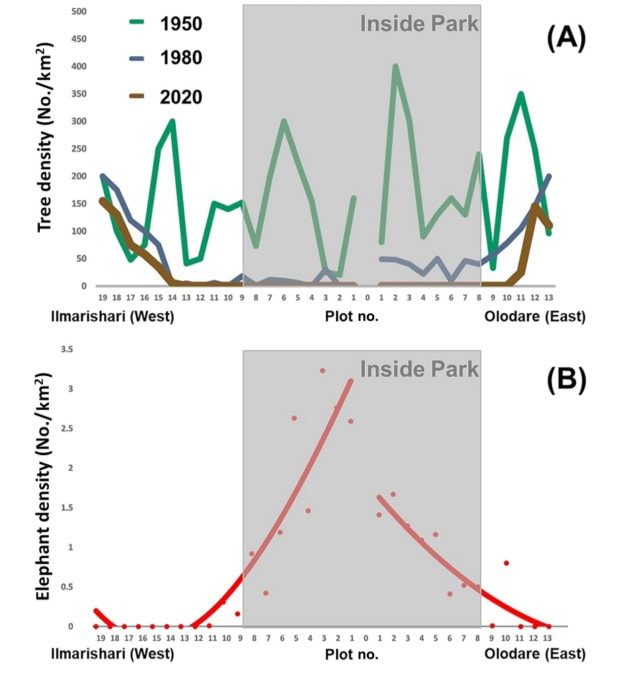
We are pleased to share our paper just released in Ecosphere. Our study tracks six decades of change in the number and distribution of elephants to document their ecological impact in response to poaching, the creation of a national park and human settlement across the Amboseli ecosystem.
We show that elephants and people, the two keystone species in the savannas, create habitat and species diversity if free to move across the landscape. The study shows the importance of space, mobility and community engagement in ensuring the vital ecological role elephants play, and in minimizing the need for population and habitat management.
Download the paper below.
Cascading effects of elephant–human interactions and the
role of space and mobility in sustaining biodiversity
We are pleased to share our paper just released in Ecosphere. Our study tracks six decades of change in the number and distribution of elephants to document their ecological impact in response to poaching, the creation of a national park and human settlement across the Amboseli ecosystem.
We show that elephants and people, the two keystone species in the savannas, create habitat and species diversity if free to move across the landscape. The study shows the importance of space, mobility and community engagement in ensuring the vital ecological role elephants play, and in minimizing the need for population and habitat management.
Download the paper below.
Cascading effects of elephant–human interactions and the
role of space and mobility in sustaining biodiversity
We are pleased to share our paper just released in Ecosphere. Our study tracks six decades of change in the number and distribution of elephants to document their ecological impact in response to poaching, the creation of a national park and human settlement across the Amboseli ecosystem.
We show that elephants and people, the two keystone species in the savannas, create habitat and species diversity if free to move across the landscape. The study shows the importance of space, mobility and community engagement in ensuring the vital ecological role elephants play, and in minimizing the need for population and habitat management.
Download the paper below.
Cascading effects of elephant–human interactions and the
role of space and mobility in sustaining biodiversity
We are pleased to share our paper just released in Ecosphere. Our study tracks six decades of change in the number and distribution of elephants to document their ecological impact in response to poaching, the creation of a national park and human settlement across the Amboseli ecosystem.
We show that elephants and people, the two keystone species in the savannas, create habitat and species diversity if free to move across the landscape. The study shows the importance of space, mobility and community engagement in ensuring the vital ecological role elephants play, and in minimizing the need for population and habitat management.
Download the paper below.
Cascading effects of elephant–human interactions and the
role of space and mobility in sustaining biodiversity