Introduction
In July we posted a report on the excellent outlook for pastures, livestock and wildlife in dry season extending from July through to the short rains in October. Good short rains in 2024, off-season rains in the January to March dry season, and heavy long rains saw Amboseli pastures recover from the 2022 drought.
The failure of the short rains in October and November, and heavy grazing following the recovery of livestock herds from the 2022 drought, have reversed the gains. The outlook for the coming dry season is severe.
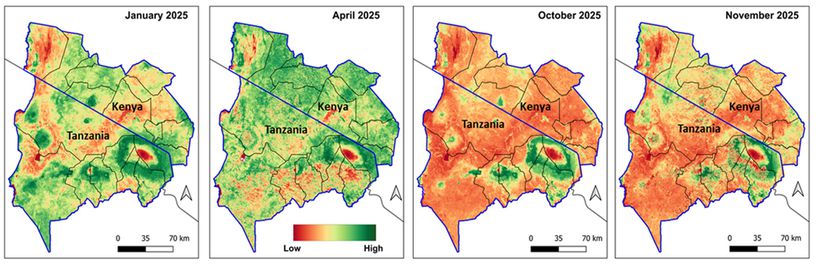
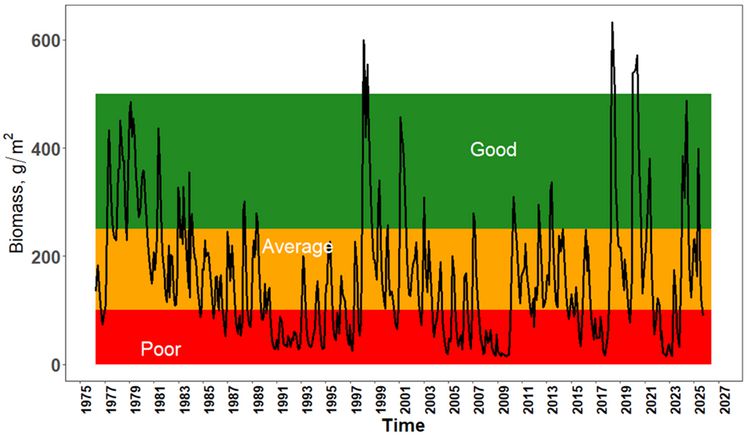
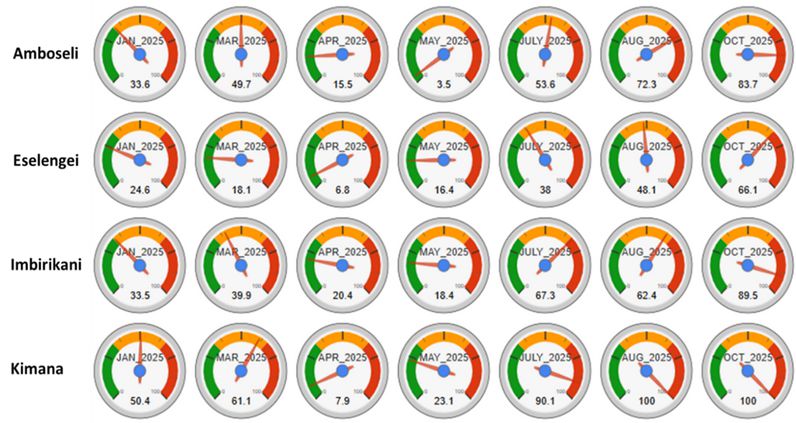
The NDVI greenness maps across southern Kenya and northern Tanzania (Figure 1) show how rapidly conditions have deteriorated since the long rains in April-May. Pastures are heavily grazed across the lowland regions from Tsavo West, through Amboseli, into the Rift Valley and across northern Tanzania. Pastures abundance has fallen steeply from the green zone into the red (Figure 2).
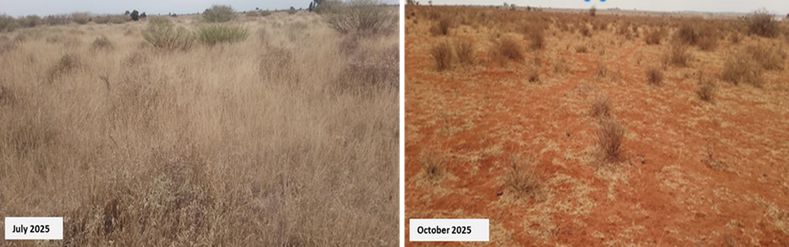
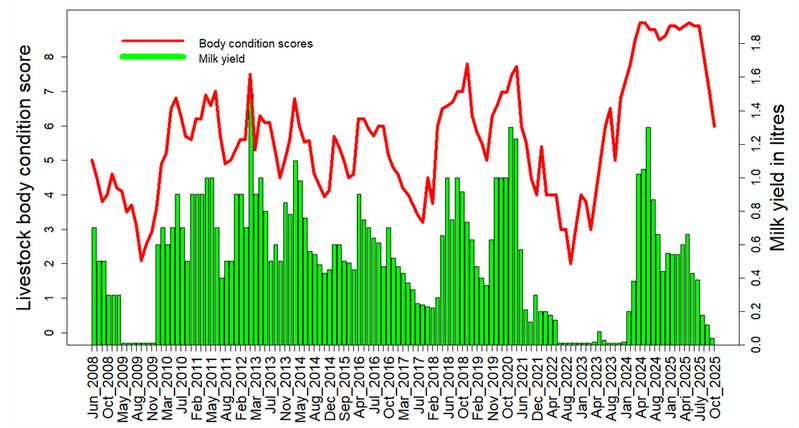
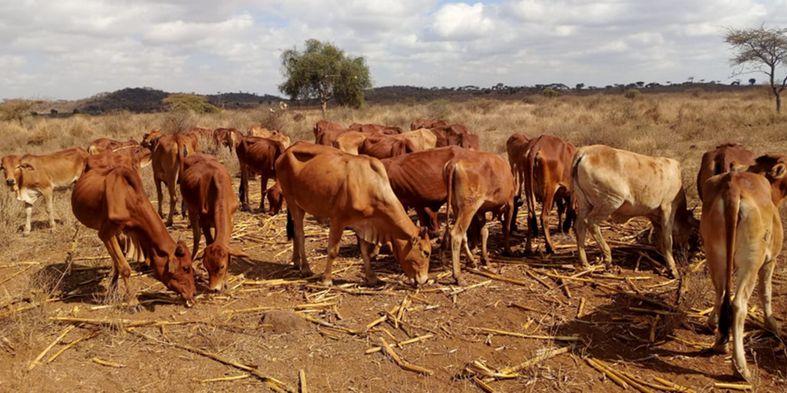
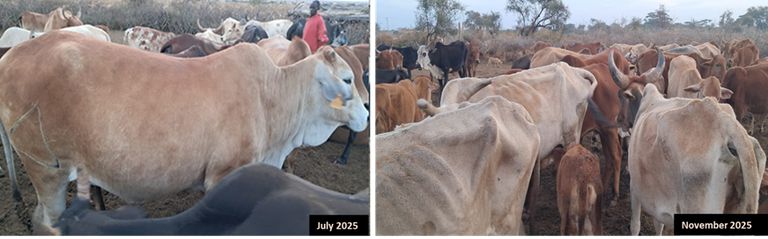
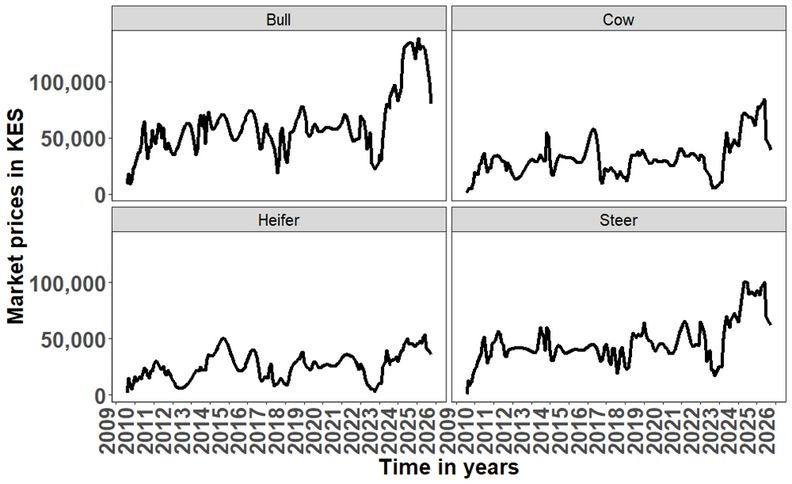
Our monitored plots show bare soil, weathered shrubs, and almost no remaining dry leaf matter. Livestock body condition has dropped sharply, milk yields are extremely low, herders are chasing the scattered green flushes, and livestock prices are falling fast.
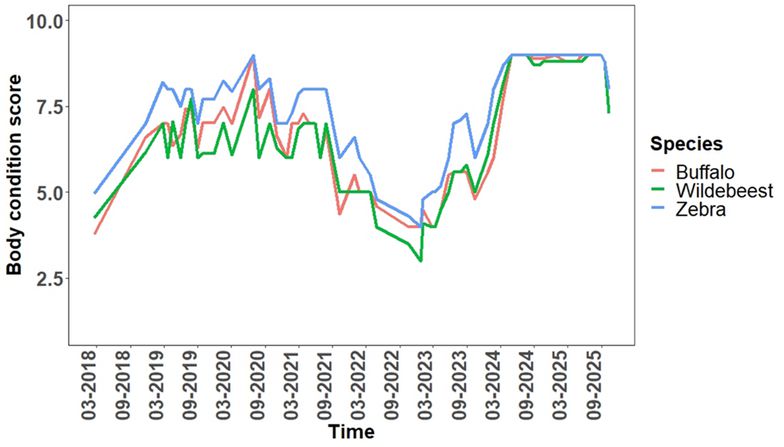
Wildlife is faring somewhat better than livestock. This is seen in the delayed drop in body condition (Figure 6) due to the far smaller wildlife numbers and greater pasture reserves in Amboseli and Chyulu National Parks. As in the 2022 drought, a large influx of cattle into the national parks could see wildlife body condition drop steeply in the coming dry season.
The sharp decline in pasture and animals condition stems from the extremely heaving grazing pressure following livestock recovery from the 2022 drought. The rapid deterioration in rangelands conditions is shown in the grazing pressure measure in our monthly pasture plots (Figure 3).
Unless delayed rains in December offer some relief, the January to March dry season will spell severe conditions for families depending on livestock and farmers bordering the pastoral lands. ACP is therefore posting an early warning alert for herders to be prepared to buy in hay before prices escalate sharply, and sell livestock before market prices drop steeply.
In the following report we detail the conditions which sound our early warning alert. We also comment on the outlook for the rangelands in the coming months, and the action needed to avert a repeat of the 2009 and 2022 droughts.
The harsh outlook calls for preventative measures
The speed with which the good pasture, livestock, milk yields, market prices and wildlife conditions have declined testifies to the heavy post-drought restocking rates suppressing the recovery of the rangelands. The suppression of pasture recovery from the 2022 drought repeats the boom-and-bust cycle of livestock production across the rangelands since the 2000 and 2009 drought (Western, 2010). Heavy grazing pressure now drives the drought cycles (Western and Mose, 2021). The deteriorating pastures incur huge losses in livestock production, pastoral livelihoods, wildlife, and intensify competition (Mose and Western 2022).
It is worth repeating findings from the post-2022 drought report by Sakimba Kimiti (Kimiti, 2023). Herders learned much from their losses in the 2009 drought when over two thirds of their livestock died. They also benefitted from the early warning alert from ACP which gave many herders time to destock and buy supplementary feeds.
The survival rates of cattle, sheep and goats were far higher in the 2022 than 2009 drought as a result. Many herders retained a core herd and breeding stock which enabled them to rebuild their herds faster after the drought. The survey showed the value of early warnings and a multi-pronged approach to drought management. Early sales at better prices avoids heavy stock losses, extreme damage to the rangelands, and ensure better recovery of the pastures and herds.
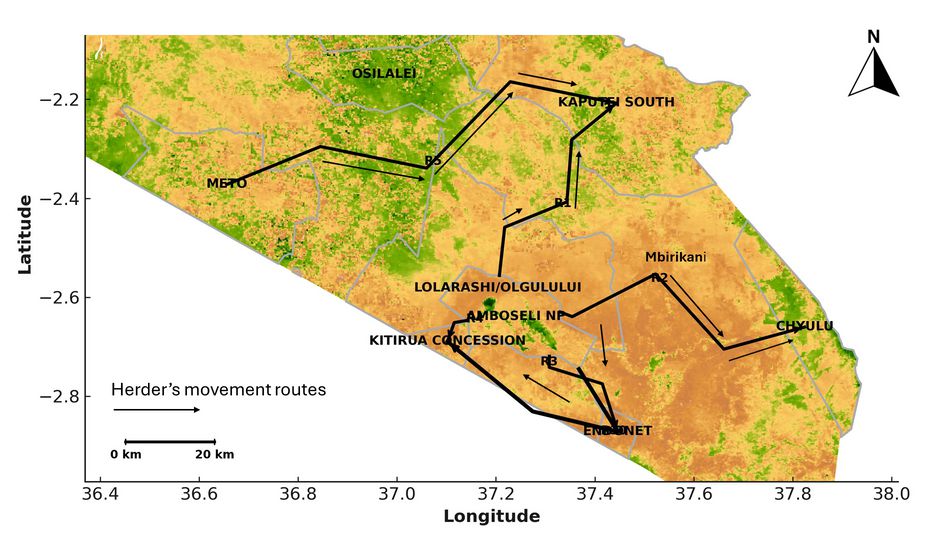
ACP early warnings also prepare herders in the Amboseli region to move their livestock to richer locations before animals are too weak to move. Herders around Amboseli are already moving cattle north to better pastures at Simba and Emali along the Mombasa Road and to the Chyulu
Hills. The movements relieve the pressure on the Amboseli rangelands and ensure better livestock survival rates.
The drought reduction measures many herders used in 2022-2023 were individual initiatives rather than coordinated action. Coordinated rather than individual action will ensure pastures are set aside as drought reserves, more efficient watering, less destruction to the rangelands, fewer livestock losses, and stronger collective bargaining power in buying food supplements to avoid price gouging.
Introduction
In July we posted a report on the excellent outlook for pastures, livestock and wildlife in dry season extending from July through to the short rains in October. Good short rains in 2024, off-season rains in the January to March dry season, and heavy long rains saw Amboseli pastures recover from the 2022 drought.
The failure of the short rains in October and November, and heavy grazing following the recovery of livestock herds from the 2022 drought, have reversed the gains. The outlook for the coming dry season is severe.
The NDVI greenness maps across southern Kenya and northern Tanzania (Figure 1) show how rapidly conditions have deteriorated since the long rains in April-May. Pastures are heavily grazed across the lowland regions from Tsavo West, through Amboseli, into the Rift Valley and across northern Tanzania. Pastures abundance has fallen steeply from the green zone into the red (Figure 2).
Our monitored plots show bare soil, weathered shrubs, and almost no remaining dry leaf matter. Livestock body condition has dropped sharply, milk yields are extremely low, herders are chasing the scattered green flushes, and livestock prices are falling fast.
Wildlife is faring somewhat better than livestock. This is seen in the delayed drop in body condition (Figure 6) due to the far smaller wildlife numbers and greater pasture reserves in Amboseli and Chyulu National Parks. As in the 2022 drought, a large influx of cattle into the national parks could see wildlife body condition drop steeply in the coming dry season.
The sharp decline in pasture and animals condition stems from the extremely heaving grazing pressure following livestock recovery from the 2022 drought. The rapid deterioration in rangelands conditions is shown in the grazing pressure measure in our monthly pasture plots (Figure 3).
Unless delayed rains in December offer some relief, the January to March dry season will spell severe conditions for families depending on livestock and farmers bordering the pastoral lands. ACP is therefore posting an early warning alert for herders to be prepared to buy in hay before prices escalate sharply, and sell livestock before market prices drop steeply.
In the following report we detail the conditions which sound our early warning alert. We also comment on the outlook for the rangelands in the coming months, and the action needed to avert a repeat of the 2009 and 2022 droughts.
The harsh outlook calls for preventative measures
The speed with which the good pasture, livestock, milk yields, market prices and wildlife conditions have declined testifies to the heavy post-drought restocking rates suppressing the recovery of the rangelands. The suppression of pasture recovery from the 2022 drought repeats the boom-and-bust cycle of livestock production across the rangelands since the 2000 and 2009 drought (Western, 2010). Heavy grazing pressure now drives the drought cycles (Western and Mose, 2021). The deteriorating pastures incur huge losses in livestock production, pastoral livelihoods, wildlife, and intensify competition (Mose and Western 2022).
It is worth repeating findings from the post-2022 drought report by Sakimba Kimiti (Kimiti, 2023). Herders learned much from their losses in the 2009 drought when over two thirds of their livestock died. They also benefitted from the early warning alert from ACP which gave many herders time to destock and buy supplementary feeds.
The survival rates of cattle, sheep and goats were far higher in the 2022 than 2009 drought as a result. Many herders retained a core herd and breeding stock which enabled them to rebuild their herds faster after the drought. The survey showed the value of early warnings and a multi-pronged approach to drought management. Early sales at better prices avoids heavy stock losses, extreme damage to the rangelands, and ensure better recovery of the pastures and herds.
ACP early warnings also prepare herders in the Amboseli region to move their livestock to richer locations before animals are too weak to move. Herders around Amboseli are already moving cattle north to better pastures at Simba and Emali along the Mombasa Road and to the Chyulu
Hills. The movements relieve the pressure on the Amboseli rangelands and ensure better livestock survival rates.
The drought reduction measures many herders used in 2022-2023 were individual initiatives rather than coordinated action. Coordinated rather than individual action will ensure pastures are set aside as drought reserves, more efficient watering, less destruction to the rangelands, fewer livestock losses, and stronger collective bargaining power in buying food supplements to avoid price gouging.
Introduction
In July we posted a report on the excellent outlook for pastures, livestock and wildlife in dry season extending from July through to the short rains in October. Good short rains in 2024, off-season rains in the January to March dry season, and heavy long rains saw Amboseli pastures recover from the 2022 drought.
The failure of the short rains in October and November, and heavy grazing following the recovery of livestock herds from the 2022 drought, have reversed the gains. The outlook for the coming dry season is severe.
The NDVI greenness maps across southern Kenya and northern Tanzania (Figure 1) show how rapidly conditions have deteriorated since the long rains in April-May. Pastures are heavily grazed across the lowland regions from Tsavo West, through Amboseli, into the Rift Valley and across northern Tanzania. Pastures abundance has fallen steeply from the green zone into the red (Figure 2).
Our monitored plots show bare soil, weathered shrubs, and almost no remaining dry leaf matter. Livestock body condition has dropped sharply, milk yields are extremely low, herders are chasing the scattered green flushes, and livestock prices are falling fast.
Wildlife is faring somewhat better than livestock. This is seen in the delayed drop in body condition (Figure 6) due to the far smaller wildlife numbers and greater pasture reserves in Amboseli and Chyulu National Parks. As in the 2022 drought, a large influx of cattle into the national parks could see wildlife body condition drop steeply in the coming dry season.
The sharp decline in pasture and animals condition stems from the extremely heaving grazing pressure following livestock recovery from the 2022 drought. The rapid deterioration in rangelands conditions is shown in the grazing pressure measure in our monthly pasture plots (Figure 3).
Unless delayed rains in December offer some relief, the January to March dry season will spell severe conditions for families depending on livestock and farmers bordering the pastoral lands. ACP is therefore posting an early warning alert for herders to be prepared to buy in hay before prices escalate sharply, and sell livestock before market prices drop steeply.
In the following report we detail the conditions which sound our early warning alert. We also comment on the outlook for the rangelands in the coming months, and the action needed to avert a repeat of the 2009 and 2022 droughts.
The harsh outlook calls for preventative measures
The speed with which the good pasture, livestock, milk yields, market prices and wildlife conditions have declined testifies to the heavy post-drought restocking rates suppressing the recovery of the rangelands. The suppression of pasture recovery from the 2022 drought repeats the boom-and-bust cycle of livestock production across the rangelands since the 2000 and 2009 drought (Western, 2010). Heavy grazing pressure now drives the drought cycles (Western and Mose, 2021). The deteriorating pastures incur huge losses in livestock production, pastoral livelihoods, wildlife, and intensify competition (Mose and Western 2022).
It is worth repeating findings from the post-2022 drought report by Sakimba Kimiti (Kimiti, 2023). Herders learned much from their losses in the 2009 drought when over two thirds of their livestock died. They also benefitted from the early warning alert from ACP which gave many herders time to destock and buy supplementary feeds.
The survival rates of cattle, sheep and goats were far higher in the 2022 than 2009 drought as a result. Many herders retained a core herd and breeding stock which enabled them to rebuild their herds faster after the drought. The survey showed the value of early warnings and a multi-pronged approach to drought management. Early sales at better prices avoids heavy stock losses, extreme damage to the rangelands, and ensure better recovery of the pastures and herds.
ACP early warnings also prepare herders in the Amboseli region to move their livestock to richer locations before animals are too weak to move. Herders around Amboseli are already moving cattle north to better pastures at Simba and Emali along the Mombasa Road and to the Chyulu
Hills. The movements relieve the pressure on the Amboseli rangelands and ensure better livestock survival rates.
The drought reduction measures many herders used in 2022-2023 were individual initiatives rather than coordinated action. Coordinated rather than individual action will ensure pastures are set aside as drought reserves, more efficient watering, less destruction to the rangelands, fewer livestock losses, and stronger collective bargaining power in buying food supplements to avoid price gouging.
Introduction
In July we posted a report on the excellent outlook for pastures, livestock and wildlife in dry season extending from July through to the short rains in October. Good short rains in 2024, off-season rains in the January to March dry season, and heavy long rains saw Amboseli pastures recover from the 2022 drought.
The failure of the short rains in October and November, and heavy grazing following the recovery of livestock herds from the 2022 drought, have reversed the gains. The outlook for the coming dry season is severe.
The NDVI greenness maps across southern Kenya and northern Tanzania (Figure 1) show how rapidly conditions have deteriorated since the long rains in April-May. Pastures are heavily grazed across the lowland regions from Tsavo West, through Amboseli, into the Rift Valley and across northern Tanzania. Pastures abundance has fallen steeply from the green zone into the red (Figure 2).
Our monitored plots show bare soil, weathered shrubs, and almost no remaining dry leaf matter. Livestock body condition has dropped sharply, milk yields are extremely low, herders are chasing the scattered green flushes, and livestock prices are falling fast.
Wildlife is faring somewhat better than livestock. This is seen in the delayed drop in body condition (Figure 6) due to the far smaller wildlife numbers and greater pasture reserves in Amboseli and Chyulu National Parks. As in the 2022 drought, a large influx of cattle into the national parks could see wildlife body condition drop steeply in the coming dry season.
The sharp decline in pasture and animals condition stems from the extremely heaving grazing pressure following livestock recovery from the 2022 drought. The rapid deterioration in rangelands conditions is shown in the grazing pressure measure in our monthly pasture plots (Figure 3).
Unless delayed rains in December offer some relief, the January to March dry season will spell severe conditions for families depending on livestock and farmers bordering the pastoral lands. ACP is therefore posting an early warning alert for herders to be prepared to buy in hay before prices escalate sharply, and sell livestock before market prices drop steeply.
In the following report we detail the conditions which sound our early warning alert. We also comment on the outlook for the rangelands in the coming months, and the action needed to avert a repeat of the 2009 and 2022 droughts.
The harsh outlook calls for preventative measures
The speed with which the good pasture, livestock, milk yields, market prices and wildlife conditions have declined testifies to the heavy post-drought restocking rates suppressing the recovery of the rangelands. The suppression of pasture recovery from the 2022 drought repeats the boom-and-bust cycle of livestock production across the rangelands since the 2000 and 2009 drought (Western, 2010). Heavy grazing pressure now drives the drought cycles (Western and Mose, 2021). The deteriorating pastures incur huge losses in livestock production, pastoral livelihoods, wildlife, and intensify competition (Mose and Western 2022).
It is worth repeating findings from the post-2022 drought report by Sakimba Kimiti (Kimiti, 2023). Herders learned much from their losses in the 2009 drought when over two thirds of their livestock died. They also benefitted from the early warning alert from ACP which gave many herders time to destock and buy supplementary feeds.
The survival rates of cattle, sheep and goats were far higher in the 2022 than 2009 drought as a result. Many herders retained a core herd and breeding stock which enabled them to rebuild their herds faster after the drought. The survey showed the value of early warnings and a multi-pronged approach to drought management. Early sales at better prices avoids heavy stock losses, extreme damage to the rangelands, and ensure better recovery of the pastures and herds.
ACP early warnings also prepare herders in the Amboseli region to move their livestock to richer locations before animals are too weak to move. Herders around Amboseli are already moving cattle north to better pastures at Simba and Emali along the Mombasa Road and to the Chyulu
Hills. The movements relieve the pressure on the Amboseli rangelands and ensure better livestock survival rates.
The drought reduction measures many herders used in 2022-2023 were individual initiatives rather than coordinated action. Coordinated rather than individual action will ensure pastures are set aside as drought reserves, more efficient watering, less destruction to the rangelands, fewer livestock losses, and stronger collective bargaining power in buying food supplements to avoid price gouging.