ACP commissioned the Department of Remote Sensing and Regional Surveys to conduct a wet season count of the Amboseli ecosystem in May to take stock of the populations of wildlife and livestock after two years of drought. As reported in earlier ACP web postings, the drought caused the death of livestock and some wildlife species at the tail-end of the long dry season in September and October of 2017. Given the poor short rains in November and December, we expected drought losses to mount in the January to March dry season this year. The losses were, however, stemmed by unseasonal rains in January and again mid-March.
A comparison of the 2018 counts with the 2017 count prior to the prolonged two-year dry spell shows that, despite the deaths of zebra, wildebeest and buffalo recorded around the Amboseli swamps last September and October, wildlife populations survived the dry years very well. A table comparing the two counts (below) shows zebra, wildebeest, grant’s gazelle, eland and impala numbers holding their own. Buffalo numbers showed a decline on the aerial counts, but the losses were not evident in the monthly ground counts conducted in Amboseli. Elephant numbers in the ecosystem were down significantly. The decline reflects emigration to surrounding areas rather than mortality, given that few deaths were recorded. Giraffe, ostrich and oryx, all drought-hardy species, increased over the past two years. The increase in giraffe is especially encouraging, given its decline across its range in Africa and its recent classification as a threatened species. The increase is due largely to containment of bush meat poaching in the Amboseli ecosystem over the last few years.
The losses of cattle, sheep, goats and donkeys, on the other hand, are confirmed by the mortality records from ground surveys during the drought. Based on our monthly vegetation plots, we expected far larger losses of wildlife than actually occurred. The wildlife survival we attribute to boost in fresh pasture created by spread of surface water in the swamps in the last two dry seasons. The losses among cattle, sheep and goats was due to the large sizes of their populations and the limited access they had to late season grazing taken up by farms and settlement.
ACP commissioned the Department of Remote Sensing and Regional Surveys to conduct a wet season count of the Amboseli ecosystem in May to take stock of the populations of wildlife and livestock after two years of drought. As reported in earlier ACP web postings, the drought caused the death of livestock and some wildlife species at the tail-end of the long dry season in September and October of 2017. Given the poor short rains in November and December, we expected drought losses to mount in the January to March dry season this year. The losses were, however, stemmed by unseasonal rains in January and again mid-March.
A comparison of the 2018 counts with the 2017 count prior to the prolonged two-year dry spell shows that, despite the deaths of zebra, wildebeest and buffalo recorded around the Amboseli swamps last September and October, wildlife populations survived the dry years very well. A table comparing the two counts (below) shows zebra, wildebeest, grant’s gazelle, eland and impala numbers holding their own. Buffalo numbers showed a decline on the aerial counts, but the losses were not evident in the monthly ground counts conducted in Amboseli. Elephant numbers in the ecosystem were down significantly. The decline reflects emigration to surrounding areas rather than mortality, given that few deaths were recorded. Giraffe, ostrich and oryx, all drought-hardy species, increased over the past two years. The increase in giraffe is especially encouraging, given its decline across its range in Africa and its recent classification as a threatened species. The increase is due largely to containment of bush meat poaching in the Amboseli ecosystem over the last few years.
The losses of cattle, sheep, goats and donkeys, on the other hand, are confirmed by the mortality records from ground surveys during the drought. Based on our monthly vegetation plots, we expected far larger losses of wildlife than actually occurred. The wildlife survival we attribute to boost in fresh pasture created by spread of surface water in the swamps in the last two dry seasons. The losses among cattle, sheep and goats was due to the large sizes of their populations and the limited access they had to late season grazing taken up by farms and settlement.
ACP commissioned the Department of Remote Sensing and Regional Surveys to conduct a wet season count of the Amboseli ecosystem in May to take stock of the populations of wildlife and livestock after two years of drought. As reported in earlier ACP web postings, the drought caused the death of livestock and some wildlife species at the tail-end of the long dry season in September and October of 2017. Given the poor short rains in November and December, we expected drought losses to mount in the January to March dry season this year. The losses were, however, stemmed by unseasonal rains in January and again mid-March.
A comparison of the 2018 counts with the 2017 count prior to the prolonged two-year dry spell shows that, despite the deaths of zebra, wildebeest and buffalo recorded around the Amboseli swamps last September and October, wildlife populations survived the dry years very well. A table comparing the two counts (below) shows zebra, wildebeest, grant’s gazelle, eland and impala numbers holding their own. Buffalo numbers showed a decline on the aerial counts, but the losses were not evident in the monthly ground counts conducted in Amboseli. Elephant numbers in the ecosystem were down significantly. The decline reflects emigration to surrounding areas rather than mortality, given that few deaths were recorded. Giraffe, ostrich and oryx, all drought-hardy species, increased over the past two years. The increase in giraffe is especially encouraging, given its decline across its range in Africa and its recent classification as a threatened species. The increase is due largely to containment of bush meat poaching in the Amboseli ecosystem over the last few years.
The losses of cattle, sheep, goats and donkeys, on the other hand, are confirmed by the mortality records from ground surveys during the drought. Based on our monthly vegetation plots, we expected far larger losses of wildlife than actually occurred. The wildlife survival we attribute to boost in fresh pasture created by spread of surface water in the swamps in the last two dry seasons. The losses among cattle, sheep and goats was due to the large sizes of their populations and the limited access they had to late season grazing taken up by farms and settlement.
ACP commissioned the Department of Remote Sensing and Regional Surveys to conduct a wet season count of the Amboseli ecosystem in May to take stock of the populations of wildlife and livestock after two years of drought. As reported in earlier ACP web postings, the drought caused the death of livestock and some wildlife species at the tail-end of the long dry season in September and October of 2017. Given the poor short rains in November and December, we expected drought losses to mount in the January to March dry season this year. The losses were, however, stemmed by unseasonal rains in January and again mid-March.
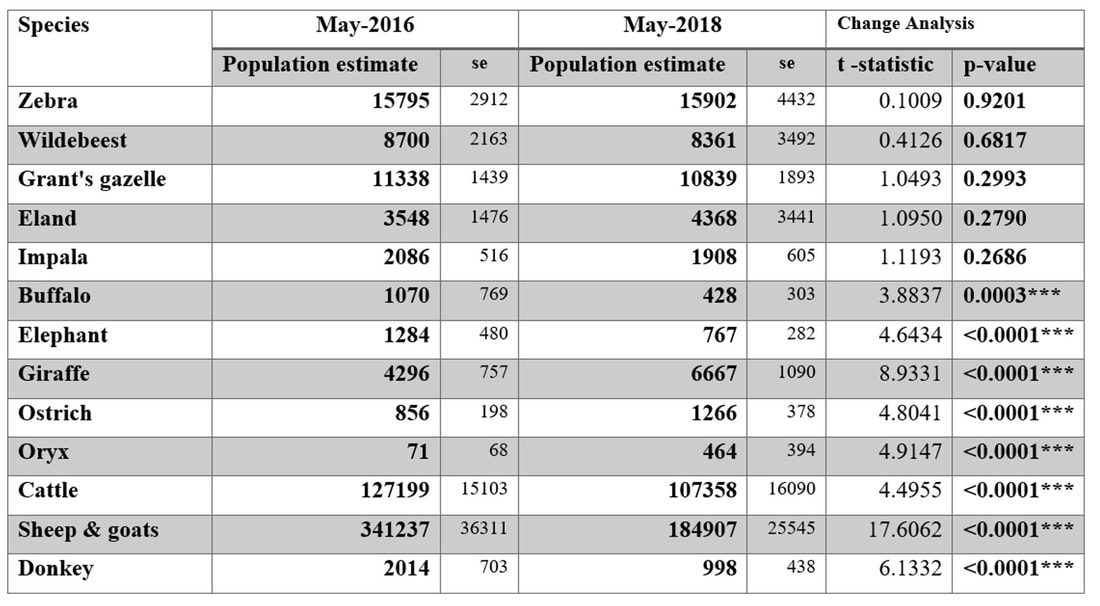
A comparison of the 2018 counts with the 2017 count prior to the prolonged two-year dry spell shows that, despite the deaths of zebra, wildebeest and buffalo recorded around the Amboseli swamps last September and October, wildlife populations survived the dry years very well. A table comparing the two counts (below) shows zebra, wildebeest, grant’s gazelle, eland and impala numbers holding their own. Buffalo numbers showed a decline on the aerial counts, but the losses were not evident in the monthly ground counts conducted in Amboseli. Elephant numbers in the ecosystem were down significantly. The decline reflects emigration to surrounding areas rather than mortality, given that few deaths were recorded. Giraffe, ostrich and oryx, all drought-hardy species, increased over the past two years. The increase in giraffe is especially encouraging, given its decline across its range in Africa and its recent classification as a threatened species. The increase is due largely to containment of bush meat poaching in the Amboseli ecosystem over the last few years.
The losses of cattle, sheep, goats and donkeys, on the other hand, are confirmed by the mortality records from ground surveys during the drought. Based on our monthly vegetation plots, we expected far larger losses of wildlife than actually occurred. The wildlife survival we attribute to boost in fresh pasture created by spread of surface water in the swamps in the last two dry seasons. The losses among cattle, sheep and goats was due to the large sizes of their populations and the limited access they had to late season grazing taken up by farms and settlement.