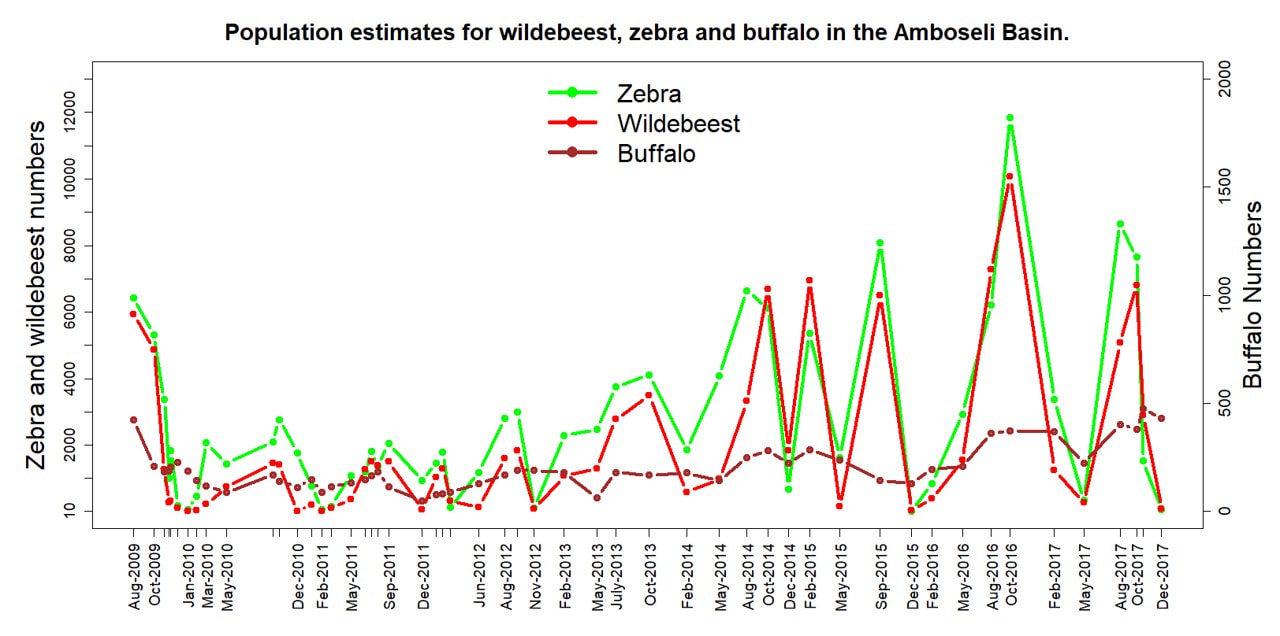
2017 saw a continuing recovery of Amboseli wildlife numbers after the precipitous losses in 2008, as shown in Figure 1. The slow recovery of zebra and wildebeest, held in check by predation until 2012, began to accelerate through to 2017 once the herds resumed their strong seasonal migrations. Zebra and wildebeest numbers tracked each other closely throughout the recovery. The downturn in the 2017 dry season may reflect fewer animals returning to the basin rather than a decline in population. Buffalo numbers remained low until 2015 when the herds began migrating with the rains to avoid heavy predation pressure and now stand at three quarters of their pre-drought levels.
Elephant numbers which peaked at around 550 in the Amboseli Basin in the late 1980s following a concentration in the park following the heavy poaching of the 1970s, declined steadily to a low of 300 at the beginning of the 2009 drought. After the loss of over 400 animals, the elephant numbers returned to a high of over 550, then fell strongly to an all-time low of a little over 200 with the resumption of drought in 2017 when little forage remained in the swamps.
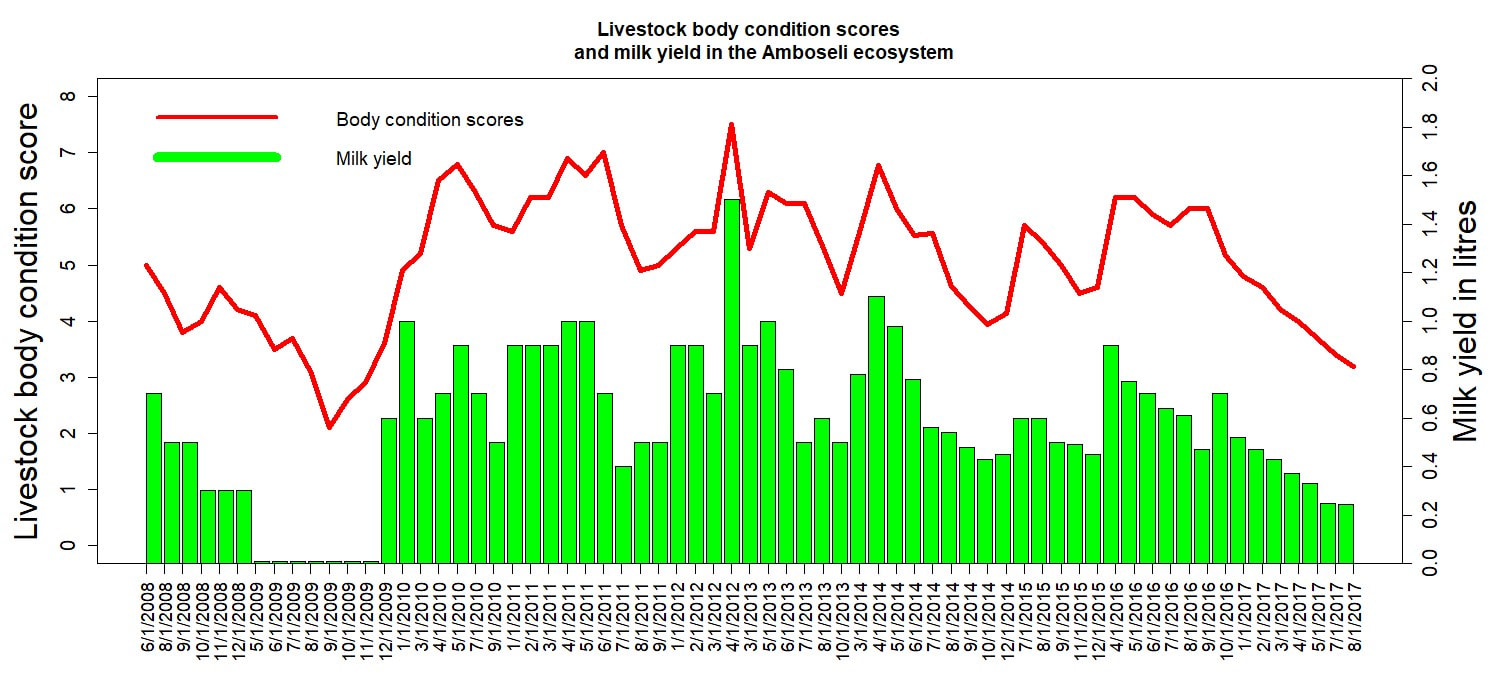
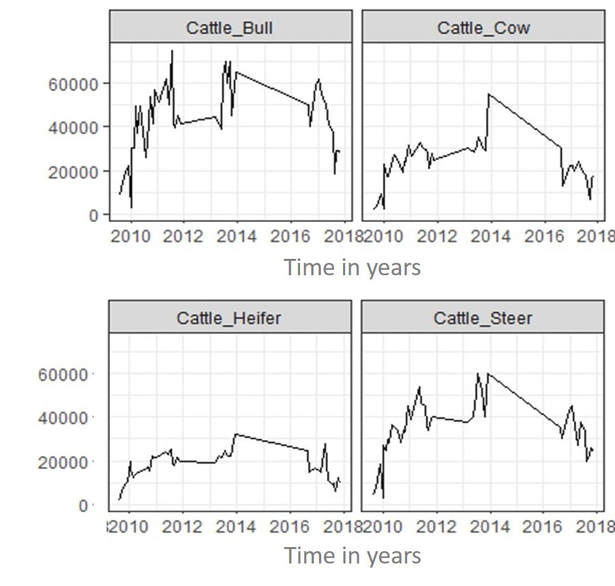
Sheep and goat numbers climbed to 179,000 by November 2017 when ACP commissioned a count of the Amboseli ecosystem, considerably down from a peak of 341,000 in 2016. Cattle numbers are also down after peaking in 2016, from 127,000 to 55,000. ACP uses many indicators to track and anticipate severe conditions. In addition to the numbers of wildlife and livestock, other measures include pasture abundance, the body condition and milk yields of cattle (Figure 2) and market prices (Figure 3) which slump in times of drought.
Taken collectively the data show the build-up of wildlife numbers and recovery of livestock condition after the 2009 drought and point to a repeat severe drought setting in late 2016 and early 2017. The declining conditions are reflected in livestock milk yields, body condition and market prices. Result are not yet in from mortality figures but for cattle are likely to be around 40 percent so far.
The 2017 short rains were forecast to be good and widespread but have been desultory and scattered over much of southern Kenya, including Amboseli. Large numbers of zebra and wildebeest carcasses have been counted around the Amboseli swamps. With the paltry rains and failure of grass to recover after years of heavy grazing, the drought conditions are likely to become extremely severe before the long rains of April 2018.
2017 saw a continuing recovery of Amboseli wildlife numbers after the precipitous losses in 2008, as shown in Figure 1. The slow recovery of zebra and wildebeest, held in check by predation until 2012, began to accelerate through to 2017 once the herds resumed their strong seasonal migrations. Zebra and wildebeest numbers tracked each other closely throughout the recovery. The downturn in the 2017 dry season may reflect fewer animals returning to the basin rather than a decline in population. Buffalo numbers remained low until 2015 when the herds began migrating with the rains to avoid heavy predation pressure and now stand at three quarters of their pre-drought levels.
Elephant numbers which peaked at around 550 in the Amboseli Basin in the late 1980s following a concentration in the park following the heavy poaching of the 1970s, declined steadily to a low of 300 at the beginning of the 2009 drought. After the loss of over 400 animals, the elephant numbers returned to a high of over 550, then fell strongly to an all-time low of a little over 200 with the resumption of drought in 2017 when little forage remained in the swamps.
Sheep and goat numbers climbed to 179,000 by November 2017 when ACP commissioned a count of the Amboseli ecosystem, considerably down from a peak of 341,000 in 2016. Cattle numbers are also down after peaking in 2016, from 127,000 to 55,000. ACP uses many indicators to track and anticipate severe conditions. In addition to the numbers of wildlife and livestock, other measures include pasture abundance, the body condition and milk yields of cattle (Figure 2) and market prices (Figure 3) which slump in times of drought.
Taken collectively the data show the build-up of wildlife numbers and recovery of livestock condition after the 2009 drought and point to a repeat severe drought setting in late 2016 and early 2017. The declining conditions are reflected in livestock milk yields, body condition and market prices. Result are not yet in from mortality figures but for cattle are likely to be around 40 percent so far.
The 2017 short rains were forecast to be good and widespread but have been desultory and scattered over much of southern Kenya, including Amboseli. Large numbers of zebra and wildebeest carcasses have been counted around the Amboseli swamps. With the paltry rains and failure of grass to recover after years of heavy grazing, the drought conditions are likely to become extremely severe before the long rains of April 2018.
2017 saw a continuing recovery of Amboseli wildlife numbers after the precipitous losses in 2008, as shown in Figure 1. The slow recovery of zebra and wildebeest, held in check by predation until 2012, began to accelerate through to 2017 once the herds resumed their strong seasonal migrations. Zebra and wildebeest numbers tracked each other closely throughout the recovery. The downturn in the 2017 dry season may reflect fewer animals returning to the basin rather than a decline in population. Buffalo numbers remained low until 2015 when the herds began migrating with the rains to avoid heavy predation pressure and now stand at three quarters of their pre-drought levels.
Elephant numbers which peaked at around 550 in the Amboseli Basin in the late 1980s following a concentration in the park following the heavy poaching of the 1970s, declined steadily to a low of 300 at the beginning of the 2009 drought. After the loss of over 400 animals, the elephant numbers returned to a high of over 550, then fell strongly to an all-time low of a little over 200 with the resumption of drought in 2017 when little forage remained in the swamps.
Sheep and goat numbers climbed to 179,000 by November 2017 when ACP commissioned a count of the Amboseli ecosystem, considerably down from a peak of 341,000 in 2016. Cattle numbers are also down after peaking in 2016, from 127,000 to 55,000. ACP uses many indicators to track and anticipate severe conditions. In addition to the numbers of wildlife and livestock, other measures include pasture abundance, the body condition and milk yields of cattle (Figure 2) and market prices (Figure 3) which slump in times of drought.
Taken collectively the data show the build-up of wildlife numbers and recovery of livestock condition after the 2009 drought and point to a repeat severe drought setting in late 2016 and early 2017. The declining conditions are reflected in livestock milk yields, body condition and market prices. Result are not yet in from mortality figures but for cattle are likely to be around 40 percent so far.
The 2017 short rains were forecast to be good and widespread but have been desultory and scattered over much of southern Kenya, including Amboseli. Large numbers of zebra and wildebeest carcasses have been counted around the Amboseli swamps. With the paltry rains and failure of grass to recover after years of heavy grazing, the drought conditions are likely to become extremely severe before the long rains of April 2018.
2017 saw a continuing recovery of Amboseli wildlife numbers after the precipitous losses in 2008, as shown in Figure 1. The slow recovery of zebra and wildebeest, held in check by predation until 2012, began to accelerate through to 2017 once the herds resumed their strong seasonal migrations. Zebra and wildebeest numbers tracked each other closely throughout the recovery. The downturn in the 2017 dry season may reflect fewer animals returning to the basin rather than a decline in population. Buffalo numbers remained low until 2015 when the herds began migrating with the rains to avoid heavy predation pressure and now stand at three quarters of their pre-drought levels.
Elephant numbers which peaked at around 550 in the Amboseli Basin in the late 1980s following a concentration in the park following the heavy poaching of the 1970s, declined steadily to a low of 300 at the beginning of the 2009 drought. After the loss of over 400 animals, the elephant numbers returned to a high of over 550, then fell strongly to an all-time low of a little over 200 with the resumption of drought in 2017 when little forage remained in the swamps.
Sheep and goat numbers climbed to 179,000 by November 2017 when ACP commissioned a count of the Amboseli ecosystem, considerably down from a peak of 341,000 in 2016. Cattle numbers are also down after peaking in 2016, from 127,000 to 55,000. ACP uses many indicators to track and anticipate severe conditions. In addition to the numbers of wildlife and livestock, other measures include pasture abundance, the body condition and milk yields of cattle (Figure 2) and market prices (Figure 3) which slump in times of drought.
Taken collectively the data show the build-up of wildlife numbers and recovery of livestock condition after the 2009 drought and point to a repeat severe drought setting in late 2016 and early 2017. The declining conditions are reflected in livestock milk yields, body condition and market prices. Result are not yet in from mortality figures but for cattle are likely to be around 40 percent so far.
The 2017 short rains were forecast to be good and widespread but have been desultory and scattered over much of southern Kenya, including Amboseli. Large numbers of zebra and wildebeest carcasses have been counted around the Amboseli swamps. With the paltry rains and failure of grass to recover after years of heavy grazing, the drought conditions are likely to become extremely severe before the long rains of April 2018.